

Disclaimer: I’ve never led operations at a hospital or health system. Caveat: I’ve talked to many, many of you who do. The consensus is it’s a mess.
You’ve got tools that don’t talk to each other; pagers and switchboards that refuse to die; a secure chat in the EHR that covers the easy stuff but sends complicated handoffs into the void. And what are you left with? A workforce beaten down by the admin gymnastics required just to figure out who to call, where, and when.
PerfectServe’s bet is simple: Remove that burden from your caregivers. They combine scheduling data with communications and engineer the pipes so that the information routes itself.
They’ve been building toward this since 1997—first modernizing after-hours message handling, next expanding into enterprise clinical communication, and then acquiring Lightning Bolt to add optimized provider scheduling to the menu.
Today, PerfectServe is a cloud platform with a routing brain that optimizes schedules and streamlines care team collaboration. It’s used by 500+ hospitals and nearly 700,000 clinicians, and increasingly powers call and transfer centers through a modern operator console.
End-to-End Care Team Collaboration
PerfectServe is best known for two things:
- A clinical communication and collaboration platform that routes messages, alerts, and results based on role, schedule, urgency, and protocol. The promise is less friction, faster time to treatment, and fewer missed handoffs.
- Advanced provider scheduling that auto-generates schedules to balance org- and department-specific rules and individual preferences.
Each solution offers tremendous value in its own right, but when deployed together, the results are far more dramatic. That’s why, in 2021, PerfectServe decided to bring these pieces together in a cloud-based, intentionally interoperable, unified scheduling and communication platform.
The platform leans into the enterprise realities of large systems. Embedded messaging in the EHR. Deep links into Epic. On-call data flowing from the source of truth. Support for pager networks during transition. And, it’s built with top-tier security standards (including end-to-end encryption and compliance with HIPAA, SOC 2, and NIST standards).
It also pushed into contact centers with its operator console, a modern cloud-based replacement for legacy on-premises hospital switchboard systems. The console enables seamless, omnichannel connections between patients and their providers.
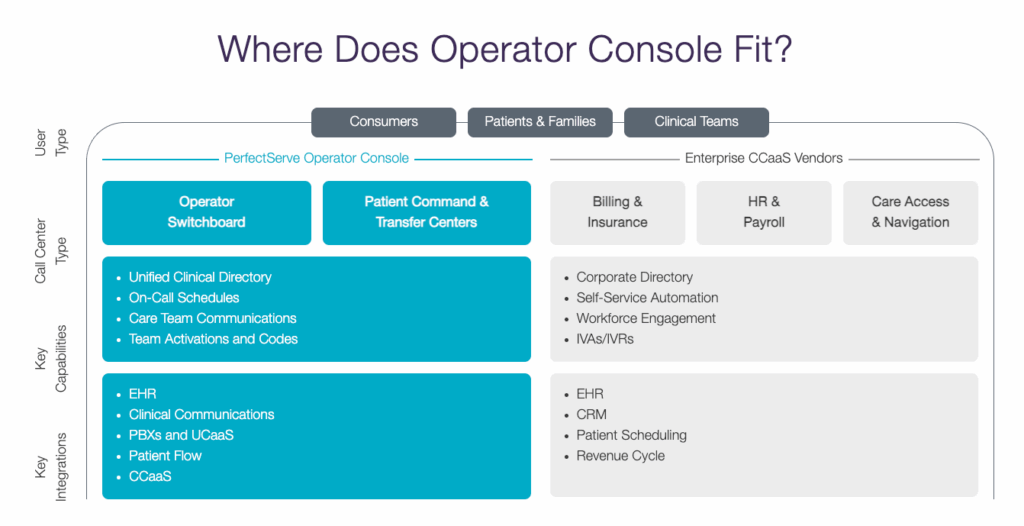
Results for a large health system in the southeast are telling: a 40% drop in time to place an accepted transfer into a clean bed and a tighter two-hour discharge-to-depart window at its largest hospital.
Then, in December 2024, the company paired that console with Five9’s Intelligent Virtual Agent to automate handling of routine inquiries and free human operators for high-value calls. Think visiting hours, room directions, and non-clinical inquiries routed by the bot, then handoff to an operator who can reach the on-call neurologist in one screen.
The partnership is exactly what administrators want to hear about AI right now: Do the simple stuff first, escalate fast when it’s not simple, and make sure the plumbing works.
Mitigating Burnout and Supporting Wellness
Clinician experience is the currency of an operating model that works. Schedules matter more than most admit, and better schedules measurably affect wellness and retention.
Lightning Bolt’s engine was built for complex rules. It searches the space of possibilities to produce the best schedule, not the first acceptable one, yielding fairer shift distribution, transparent time off, and fewer back-to-back grinds. Administrators set hard rules and soft preferences; the engine honors what matters most.
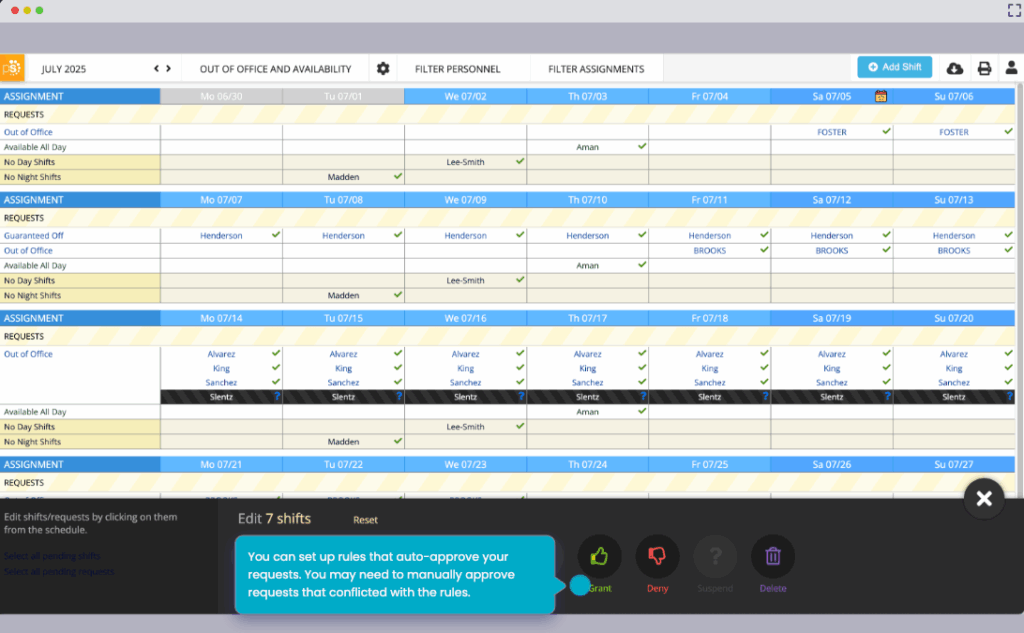
Outcomes back this up. At Ochsner Health, anesthesia physician engagement rose nearly 30% within six months; time-off approvals increased 55%. At UK Healthcare, schedule automation returned 1,200+ hours to operations.
The point: scheduling is a wellness lever, not a clerical task. Ease the schedule and call burden, and engagement follows, then retention, then lower staffing costs.
Nurses benefit when noise is reduced, non-clinical calls route to support staff, and messaging is embedded in the EHR, returning minutes to the bedside that compound into retention and stability.
Fixing Fragmented Clinical Workflows
When communication failures happen, patient harm and added cost are likely to follow: triage texts that don’t escalate, consults that bounce, lab results that sit unacknowledged because the system can’t find the right recipient.
PerfectServe’s answer is routing smart enough that tasks self-resolve. Dynamic Intelligent Routing® uses a rule-based algorithm to consider on-call rosters, patient assignments, time of day, role, service line, and urgency, moving information to the right clinician and escalating when needed. That’s different from a secure chat inbox that assumes the sender already knows who to contact.
The difference shows up in cycle times. In one case study, a large musculoskeletal center automated workflows and cut the time to accept responsibility for critical lab results to as little as 7 seconds. Reported outcomes include:
- Rapid response wait time down 73%
- Critical lab result acknowledgment down 42% (as fast as 7 seconds)
- PACU discharge time cut 26% (90 to 67 minutes)
- First-year savings of $816K (and $680K+ annually) from retiring pagers and answering services
You can zoom out and see the risk picture. A full 44% of malpractice claims citing communication as a root cause resulted in the patient suffering serious harm or death.
One more practical layer matters: clinical teams don’t live in one system. If your platform can’t route, escalate, and cross organizational boundaries, you’re paying for a walkie-talkie with a nicer user interface.
You need alerting from nurse call and telemetry, you still have pager networks in pockets, you use enterprise phones, and you are not the only hospital in town. PerfectServe’s integration catalog reads like a cross-section of that universe.
It integrates with Epic, Oracle Health, MEDITECH, nurse call vendors, paging networks, PBX systems, and more. These are the small seams that can keep a day in the life of a nurse or hospitalist from unraveling.
Consolidating Solutions for Cost and Efficiency
Everyone talks about saving money with vendor consolidation; few publish numbers. In a widely shared post, CEO Guillaume Castel outlined a familiar scenario: 14 point solutions cost $2M/year. Consolidate into PerfectServe’s platform and the outlay drops to $700K, a potential $1.3M in direct savings before counting fewer people needed to manage on-prem systems.
The soft side matters, too. Communication breakdowns add friction and costs your ledger rarely captures. Every minute saved in communication loops rolls into shorter lengths of stay, faster transfers, and fewer readmissions. Every minute returned by automation is a minute of care instead of chase.
Consolidation isn’t all-or-nothing. Some organizations keep pagers for a while. Many rely on EHR messaging for simple cases. Others phase in scheduling service by service. The point is reducing tools without forcing a rip-and-replace approach. With 250+ integrations across clinical, IT, and telecom systems—and embedded messaging and directory sync—PerfectServe supports gradual transitions and mixed environments.
Better Together: Why Scheduling and Communication Belong On One Platform
Most health systems start by buying secure messaging or an answering service replacement. Many separately modernize provider scheduling. PerfectServe’s core belief is that the whole is larger than the parts. When schedules are accurate and dynamic, your routing gets smarter. When routing is reliable, your on-call burden gets lighter.
Tie them together under one roof with real interoperability, and you can shrink the toolset without shrinking capability.
You can see it in the field: Epic on-call finders display Lightning Bolt schedules as the source of truth; call center agents see who’s on call without leaving their screen. When a critical result lands, the platform already knows the right role and schedule to reach. Case scheduling can draw from the same rules that equalize nights and weekends.
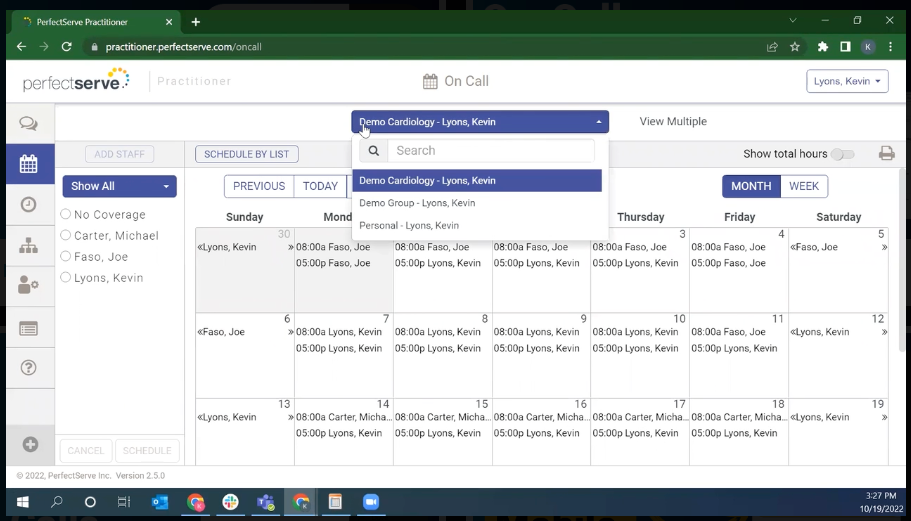
Of course, that doesn’t stop the EHR question from coming up in leadership meetings. Should you just use what your EHR already includes for secure messaging and scheduling?
PerfectServe takes a practical stance, pointing out that common EHR messaging tools are fine for simple, non-urgent cases but lack enterprise-grade escalation, sophisticated routing across roles, service lines, and time of day, and easy communication with clinicians who operate outside the EHR’s walls.
PerfectServe isn’t meant to compete with your EHR. It makes your EHR a better communicator. And on the scheduling side, Lightning Bolt’s schedule optimization is a different class of engine from what EHRs typically offer today.
The benefits of this design show up in case studies:
- University of Tennessee Medical Center: Nurse satisfaction with communication rose 28%. Embedded messaging let clinicians complete communication inside the EHR without losing PerfectServe’s routing strengths.
- Ochsner Health: Time to create and publish schedules dropped 79%, from 67.5 hours to 14 hours per month.
- A Michigan acute care hospital: Implemented a single-call “Code Stroke” that cut neurologist response time by 90%, nearly halved door-to-CT time, and tripled tPA treatments, with overall stroke volume unchanged.
The Integration Philosophy That Actually Plays in the Real World
The sentiment I heard repeatedly in conversations with PerfectServe leadership is worth printing plainly:
“Our view is that when we walk into an environment that has made decisions over the last five, ten, sometimes fifteen years, our job is not to tell those organizations that they have made bad decisions. Our job is to help them make the most of what they have decided to do over the last five to ten years, and use PerfectServe as a way of enhancing those capabilities.”
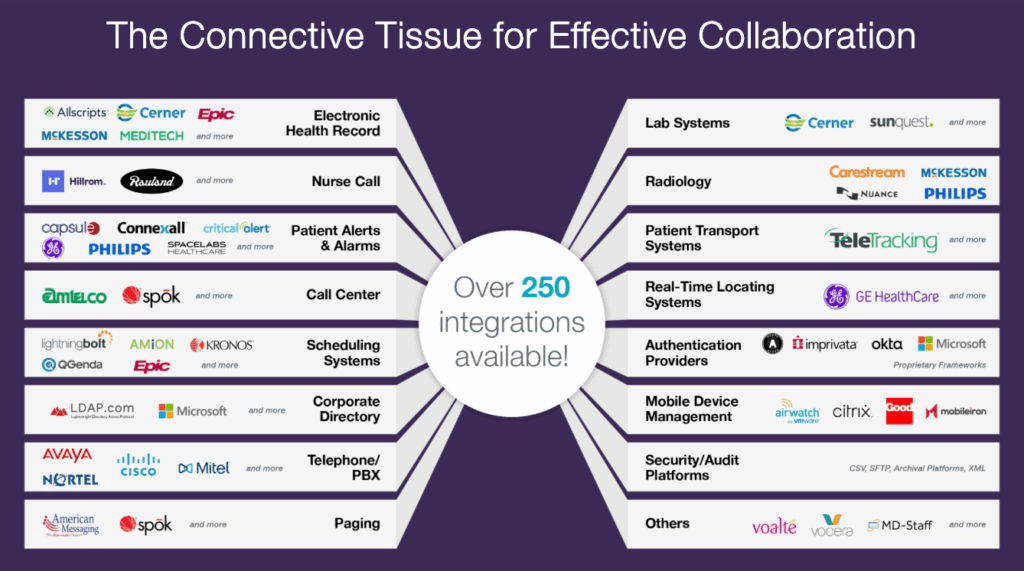
This focus on interoperability shows up again and again in their product and partnerships. Why play nice with your competitors? Because your customer asked for it (and the mission demands it).
PerfectServe’s differentiator isn’t a shiny feature, it is an attitude (backed by engineering). Make the EHR better. Accelerate speed to care. Invest in the boring plumbing that returns time to healthcare workforces.
And it’s a commitment to be a partner that delivers both tech and trust. Educate first. Meet the customer where they are. Back up your promises with measurable, repeatable results.
Most Vendors Say Their Tech Improves Patient Care…
PerfectServe frames it differently. Give clinicians a platform that removes friction and gets communication right. They’ll do the rest.
If you’re evaluating this space, check out PerfectServe’s website. Read the comparison with EHR messaging, look at the various outcomes from multiple case studies, see their press release about their dual 2025 Best in KLAS awards, and sit with your call center leaders to discuss pain points. Then do the math on consolidation. Chances are good that the ROI will speak for itself.
Join my Hospitalogy Membership! If you’re a VP or Director working in strategy or corporate development at a hospital, health system or provider organization, you will get a lot of value out of my community as I purpose-build the content, fireside chats, and conversations for this group. Apply Here.
