

For years, Commure has held a bit of a mystique in healthcare circles. Start a conversation about the company and you’ll often hear the same question: “I know about Commure, but what does Commure do, exactly?” In truth, ask Commure leadership themselves and they’ll admit Commure’s past identity has been a bit of an amalgamation.
Well Hospitalogists…today is your lucky day. Because not only is today the day we all get to finally understand what Commure does, we also are going to dive headfirst into the compelling value they deliver every day to partner health systems like HCA and Tenet through the Commure platform.
I’ve been chatting with Commure leadership and am excited to show you guys an inside look into who Commure really is. After half a decade of pivots, acquisitions, and internal strategy sessions, Commure’s ultimate vision as a next generation platform for healthcare has come into focus.
Today, we’ll dive into Commure’s builder mentality and how their team of experienced operators and forward-deployed engineers is in the thick of solving healthcare pain points for the long haul. We’ll also discuss the culmination of Commure’s grand strategy over the years to infuse ambient AI with an end-to-end revenue cycle management platform for hospitals, health systems, and provider organizations to improve cash flow, reduce denials, and leverage AI scribing for cleaner, better, faster documentation for CDI teams.
Let’s dive in.
Commure Deep Dive: Executive Summary
- Commure has built solutions that support end-to-end RCM. For example, its Ambient AI documentation solution creates specialty aware notes, and applies autonomous coding to aid in initial claim submission.
- They provide hard, tangible ROI for hospitals and health systems looking for a single EHR agnostic platform with wide-ranging capabilities, from denials management to patient intake, to ambient documentation integration into CDI teams.
- Commure harnesses the best minds in technology to build an AI platform that eliminates documentation burden, brings patients and providers closer together, automates revenue, and transforms healthcare end to end.
- Get in touch with the Commure team here!
Commure’s Journey to Today
From day one, Commure leadership aimed to create a modern backbone for health systems dealing with a backwards industry. Full stop. Commure’s ethos was radical collaboration, knowing that this broken industry needed (needs) extreme change to find a sustainable future. Commure’s namesake, a play on “common architecture,” hints at bringing systems together. See – there’s already a fun fact you didn’t know about them!
Adding value is Commure’s north star. In a landscape crowded with thousands of vendors, point solutions can’t keep up. True impact comes from platforms that solve real problems and deliver measurable, hard ROI. Soft ROI may sound appealing, but it’s difficult to prove—and in today’s AI-enabled world, healthcare leaders are inundated with more noise than ever. If you can’t clearly answer why your solution matters and how it delivers value, you’re dead on arrival. For Commure, every product decision centers on one simple question: how do we help health systems increase revenue, reduce costs, and enhance the provider and patient experience?
What Commure Actually Does
Commure is building AI infrastructure for the future of healthcare, consolidating point solutions into one integrated platform. Over the years, Commure has assembled a healthcare software suite across a multitude of pain points. Today its solutions include:
- Revenue Cycle Management: End-to-end automation for coding, prior authorization, eligibility, submissions, posting, and appeals.
- Ambient AI: Ambient AI-powered clinical documentation that enhances clinician workflows with autonomous coding, proactive care nudges, and seamless EHR integration.
- Patient Experience: AI-powered digital care pathways that improve patient experience, access, and outcomes.
- Agents: Dynamic AI-driven automation to streamline the tasks from patient front call center to denials management.
- PatientKeeper Platform: All-in-one AI-powered rounding, charting, and coding seamlessly integrated into the EHR.
…And other patient and staff safety enhancing solutions such as Strongline, powered by Canopy.
Behind the product suite today has been no shortage of health tech deals. M&A has always been part of the company’s DNA, and it’s assembled a healthcare software suite over the years including: PatientKeeper (an established EHR extension platform with clinical and billing workflows), Strongline (an RTLS-powered duress system for healthcare workers), and Augmedix (a pioneer of the Ambient AI scribe).
Critically, Commure merged with Athelas in 2023. Tanay Tandon became CEO of the combined company, joined by his Athelas cofounder Deepika Bodapati as COO and Dhruv Parthasarathy as CTO. Overnight, Commure gained Athelas’s booming RCM business and AI engineering firepower, not to mention a charismatic leader to carry the vision forward. General Catalyst poured in fresh capital at a multibillion valuation to back this union. As Tanay wrote, each company had grown dramatically over three years, and together they formed a formidable platform.
Commure’s vision remains to create one of the largest, most comprehensive, and fastest growing AI software suites in healthcare, powering millions of physician appointments a year with AI driven scribing and workflow automation.
Their work has culminated in one distinct area of convergence: ambient AI and revenue cycle management. Today their platform delivers integrated solutions designed from the start to feed every workflow––front-end, care delivery, and back-end––into revenue. They connect into Commure’s core thesis, which is simple, but powerful: Eliminate the tedious grunt work in healthcare so providers can focus on patients.
The Power of a Platform and the Convergence of Ambient and RCM

From a pure, cold revenue cycle and financial perspective, health systems need fewer vendors to help them move the two numbers that matter most: Net revenue per unit of volume, and cost to collect on services rendered.
Commure’s claim (pun totally intended) is simple. A single platform that spans intake, documentation, and the revenue cycle produces better financial results than a pile of vendors that do not talk to each other. A health system does not have to start with all of its parts, but can build its way toward the end-to-end AI platform that increasingly compounds value.
Commure reduces documentation time, enhances accuracy, streamlines claims, minimizes denials, and accelerates reimbursement. The platform and its integrations sit next to the core EHR and plug into the rest of the tech stack rather than trying to replace it.
How the Commure Platform Works Across the Revenue Cycle
Here’s a quick overview from an internal Commure deck that folks can take back to their respective hospitals to learn more about its various RCM functionality.
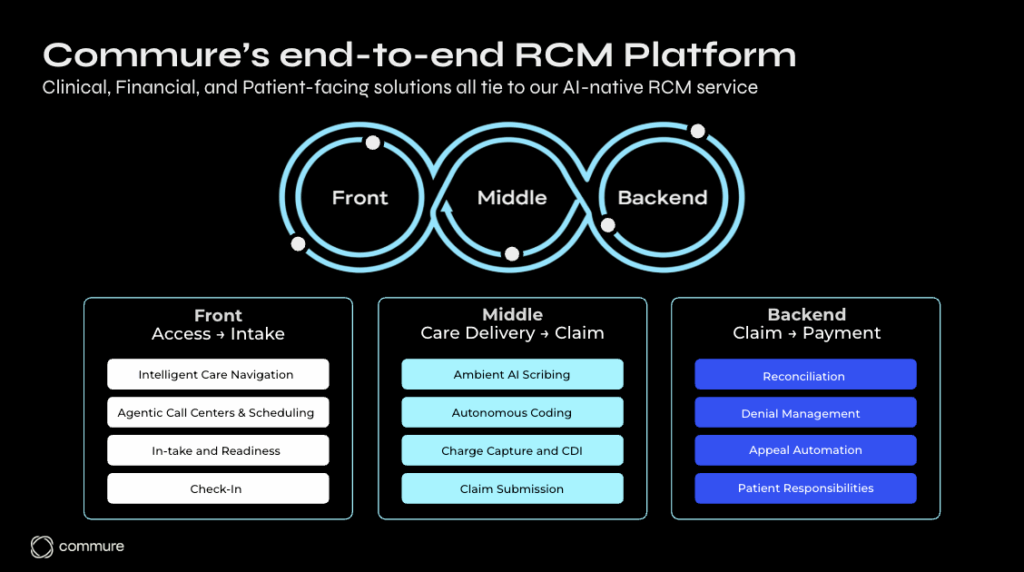
Front end. Patient Experience Platform
- Intelligent intake, omnichannel scheduling, and pre-visit readiness validate coverage, capture demographics and benefits, and collect up front.
Middle. Provider Platform
- AI automation and RCM optimized documentation support each stage at the point of care, including ambient AI scribing, compliant autonomous coding, charge capture and CDI, and claims submission.
Back office. Financial Platform
- Automation across coding, claims, denials, and appeals with an always current payer rules engine.
The Flywheel.
Every product Commure builds is designed to create momentum for health systems as a flywheel of efficiency, insight, and return. Accurate data capture fuels better documentation. Better documentation drives correct coding. Correct coding leads to faster reimbursement and fewer denials. AI-driven patient experience and communication enhances access and outcomes. Each cycle feeds the next, compounding value across operations and care.
This is what happens when solutions run on a unified platform rather than scattered point tools. More than 150 hospital systems, hundreds of independent groups, and over 350,000 clinicians already use Commure to connect their workflows. With integrations across 60+ EHRs and tens of billions in annual claims processed, the flywheel keeps accelerating, driving measurable ROI, reducing costs, and enhancing both provider and patient experiences.
The Hard ROI.
- Reduced cost to collect, and higher reimbursement – Reported customer outcomes include 21% higher collections at a large New York system and 12% higher revenue per encounter at a Utah specialty clinic.
- For denials management – reported performance includes 97% first pass claim accuracy and denial rates below 2% in mature programs.
- Patient intake – reported outcomes include up to a 50% reduction in no shows and a doubling of patient payment collections.
- Ambient → coding and documentation synergy – reported outcomes include a 19% drop in denials at facilities using ambient compared with 4% elsewhere inside the same enterprise and a 31% reduction in documentation errors in large hospital settings.
What Makes Commure Different
Buyers hear a lot of platform talk. Here’s how Commure differentiates:
- It starts with smart people. Commure’s leaders say their strength comes from the teams who deeply understand healthcare and build with intent.
- They design for every stakeholder across the care continuum, not just providers or revenue teams. Their platform connects them all seamlessly.
- Forward-deployed engineers sit side-by-side with providers and end users, shaping workflows around their realities instead of forcing them into Commures’. That closeness is what accelerates adoption and impact, and cuts development cycles in half.
- Transparency is the operating norm. Leaders watch work move across access, coding, denials, and appeals without guessing. Staff understand why a claim was routed or flagged. Clinicians can see how a single detail in the note shifts coding and risk. When everyone sees the same truth, decisions speed up and rework fades.
And, finally, it’s the culture. For all its high flying deals, Commure holds a culture that fuses Silicon Valley agility with healthcare humility. The company believes technology must be codeveloped hand in hand with the people using it. Radical collaboration is baked into Commure’s DNA. Big bets are encouraged. And white glove, concierge level support is repeatedly cited as a strength by customers.
Commure and the AI-Enabled Future
So, what does Commure actually do?
Commure delivers next-generation AI infrastructure for enterprise health systems and practices, integrating ambient intelligence, agentic AI, and revenue cycle automation on a single platform. The Commure platform is all about connecting siloed parts of healthcare into one ecosystem. They’re attempting to do for hospitals what an operating system like Windows did for PCs decades ago: provide common services and interfaces so that countless functions can work together in harmony – and each compounding with data enriched by the other component.
Like any venture, Commure faces integration challenges, competition, and the perennial hurdle of selling to conservative hospital administrators. But its trajectory is up and to the right. Commure has an expanding war chest, a growing base of evangelist customers, and a clearer identity than ever before. Commure has the potential to be one of the central players in the new era of healthcare AI and automation.
In the end, the whimsical truth is this: Commure became the company where nobody knew what it did, because it dared to do it all. Hopefully moving forward we all know what Commure does now: it makes healthcare work like it should. And that is a narrative worth following to its next chapter.
Get in touch with the Commure team today.
Join my Hospitalogy Membership! If you’re a VP or Director working in strategy or corporate development at a hospital, health system or provider organization, you will get a lot of value out of my community as I purpose-build the content, fireside chats, and conversations for this group. Apply Here.