
The Revenue Cycle Has an Infrastructure Problem. R1 Built the OS to Solve It.
Partnered with

Trusted by 95 of the top 100 U.S. health systems, R1 is rethinking revenue cycle with a new architecture built for today’s reimbursement reality.
Learn what’s next for RCMTL;DRCopy anchor linkCopied
- There is nothing hotter in healthcare right now than AI in revenue cycle management (RCM)
- The rev cycle’s core problem is infrastructure, and the solution is a system that finally aligns how healthcare is documented with how it gets paid
- R1 launched Phare, healthcare’s first revenue operating system, positioned as the category-defining intelligence layer between clinical and financial systems
- Phare OS is built on a unified data foundation with connections to 1,500+ payors and 600M+ annual transactions, with every module sharing intelligence across the full revenue cycle so that back-end denials inform mid-cycle rule adjustments in real time
- Phare OS is already live and producing results: Phare Claim is hitting autonomous coding accuracy rates as high as 97%, and early implementations signal that the transition to an AI-driven OS doesn’t have to mean displacing people
Get in touch with the R1 team today to learn more about the new OS for RCM.
Fewer than 2.5% of healthcare claims are ultimately denied. So why does the industry spend more than $200 billion a year fighting over them?
Because the revenue cycle was never built to be efficient. For every hospital encounter, the patient record generated could contain 30,000 discrete data points, and before a health system sees a dollar of reimbursement, all of it has to be translated into the language of payors. Not one language: a thousand dialects, each with its own rules, documentation thresholds, and coverage requirements, and all of them constantly shifting. The industry’s answer for decades was more labor. That model is broken: 90% of revenue cycle teams are understaffed, attrition can exceed 40% in operations centers, and 12% of claims are denied on first pass, only to be appealed, reworked, and eventually paid anyway at enormous cost.
In every segment of healthcare, problems are arising in data and infrastructure. And the future-proofed solution is a system of intelligence that finally aligns how healthcare is documented with how it gets paid. This is exactly what R1 has built.
You can’t automate your way out of a broken systemCopy anchor linkCopied
Healthcare is adopting AI faster than it has embraced any technology in a generation. But what I’m worried about is further entrenchment of already-broken processes.
Drop an AI point solution onto a process that was terrible to begin with and you get a faster broken process. A prior auth bot over here, a denials tool over there, none of them talking to each other, each one automating a single busted step in a chain that stays busted.
Most health system leaders are still finding RCM challenging – and increasingly so in today’s world of denials and downcoding. Many still haven’t clawed back to pre-COVID profitability while costs keep climbing, which means the old reflex of throwing bodies at the problem is now a luxury almost nobody can afford. When I talked with R1’s team, they kept landing on the same point: this generation of AI finally makes it possible for a health system to do work it simply cannot staff for today, not to hollow out the people it already has. Of any space in healthcare, investment in RCM contains the clearest path to financial ROI: collecting what you’re owed. Receiving dues for the services already rendered.
Here’s how R1 is shifting the paradigm back to hospitals and health systems with its new revenue cycle operating system – a first of its kind end-to-end system of intelligence, built natively with AI.
Revenue cycle finally gets its own OSCopy anchor linkCopied
In October 2025, R1 launched Phare, healthcare’s first revenue operating system.
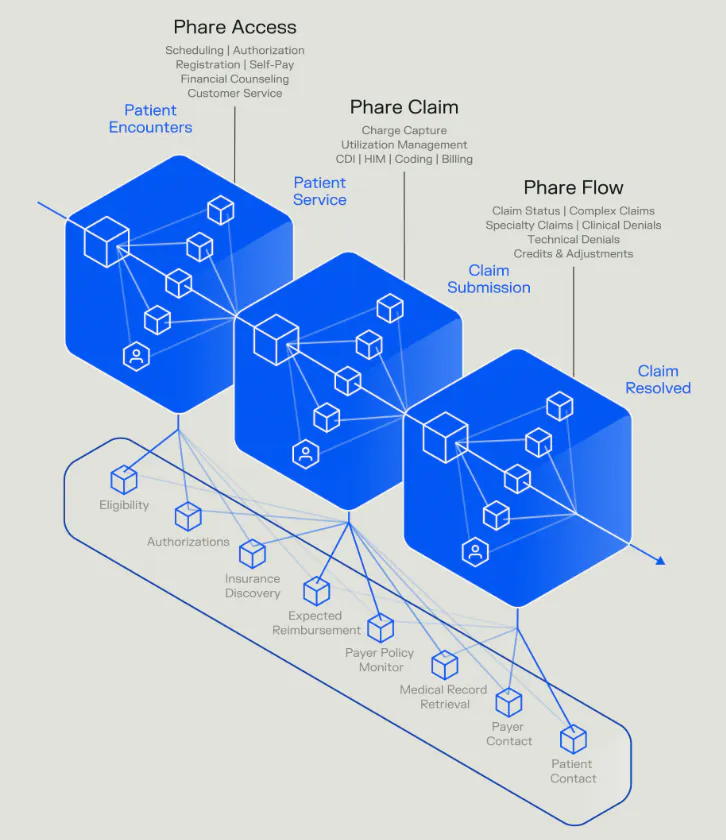
Phare OS is an intelligent platform that connects clinical and financial workflows end-to-end and translates complex patient data into payor-ready, auditable claims across the full revenue cycle.
I want to emphasize that while health systems can bolt on parts of the platform, R1 isn’t positioning Phare OS as a smarter denial tool or a faster coding engine. R1 is positioning Phare as a category-defining end-to-end RCM platform. Here’s the distinction that matters: Epic owns the clinical system of record. R1 is making a run at the system of action for revenue — the layer where the money actually gets decided.
What makes that credible is 20-plus years of operational history embedded into the platform — every transaction, denial, and payor response becomes intelligence the system learns from. Revenue cycle is a long-tail problem, and a model trained on a narrow slice of the payor landscape will fail at the edges that matter most. R1 has seen those edges. Repeatedly. Across hundreds of hospitals and health systems and millions upon millions of claims.
R1’s tech stack behind the OSCopy anchor linkCopied
Phare OS is designed to bring all the workflows of the revenue cycle into a single platform. This starts with the foundational layer:
- Phare’s Data Platform, a unified layer that pulls together real-time clinical and financial data from EHRs and other sources into a single coherent view.
- Payer Atlas, R1’s proprietary payor intelligence engine with connections to more than 1,500 payors and visibility into over 600 million transactions annually
- Phare Intelligence, which autonomously interprets and translates the entire medical record, regardless of size, into accurate medical necessity, codes, and appeal justifications
These foundations power a connected suite of solutions, including Prior Authorization, Audit and Denials, and none of them operate in silos. Intelligence generated at one stage of the revenue cycle actively informs what happens at every other stage. When something gets denied on the back end, that information flows back upstream and informs rule adjustments in the mid-cycle. And because the system learns from its own outcomes, what might have generated a denial last month gets resolved before the claim is ever submitted next month.
For the first time, RCM holds a powerful tool – a proactive agentic action layer. For years, the industry has treated denial management as a back-end problem, something you fix after the claim comes back rejected. Phare OS is designed around a different premise: get the mid-cycle right and the denials don’t happen in the first place. R1’s clinical and coding experts remain in the loop, stepping in where judgment calls matter and maintaining a full audit trail. Appeals are expensive, slow, and demoralizing, and every one of them is a claim you should have gotten right the first time. R1 designed the system to intervene where documentation and coding actually get decided, before a claim is ever submitted, so prevention does the work that armies of back-end reworkers used to do.
The platform itself is built out of R37, R1’s dedicated AI lab, and in partnership with some of the most advanced names in enterprise AI: Sierra for voice AI, Anthropic, and Databricks for data infrastructure.
One of the more strategically important things about Phare OS I’ll point out again is its modular architecture. The revenue operating system is the north star, but health systems can start with targeted solutions that address specific pain points while still benefitting from platform-wide scale and intelligence. Phare Audit, for example, is a natural entry point for mid-cycle CDI and coding integrity work that delivers validation upstream to optimize reimbursement.
Every RCM buyer’s real question: is it real?Copy anchor linkCopied
Ask anyone evaluating AI in the revenue cycle and you’ll hit the same wall of skepticism, because the category is thick with vendors promising things their software can’t do. R1’s team named the question for me without flinching: “is it real?”
On the performance side, an example of the early results they’re seeing: Phare Claim is hitting autonomous coding accuracy rates as high as 97% across service lines like emergency room and physician office visits.
And currently R1’s most prominent live Phare OS implementation, with Singing River Health System, is a great example for others to learn from or talk to. R1’s partnership approach (under-promise, over-deliver, stay embedded through implementation rather than selling software and waving goodbye) offers flexibility.
Unlike more traditional enterprise RCM relationships, Singing River has retained its own revenue cycle staff. The health system’s team works alongside Phare OS rather than being transitioned out. Nobody has lost their job. That model addresses one of the biggest psychological barriers health systems face when considering a shift like this: what happens to their people.
Paradigms are shifting around the healthcare industry and revenue cycle management. It’s time to rethink and look to the future.Copy anchor linkCopied
R1 has spent 20-plus years known as the end-to-end revenue cycle partner for the country’s largest health systems, the outsourcer you hand the whole function to. Phare OS is the company’s proof point that it’s something much greater, and more profound now: a healthcare technology company that happens to know more about getting paid than anyone else in the market.
Plenty of companies can wire up an LLM. Very few have watched 600 million payor transactions a year for two decades and know precisely where and why the claims break. Technology without that intelligence is just tech for its own sake, and R1’s whole pitch is that it owns both halves.
What R1 is building with Phare OS is different, and that’s exactly the point. It’s not AI layered on top of the traditional revenue cycle model. It’s a rethinking of the model itself — a new architecture that treats revenue cycle as a system of intelligence rather than a sequence of disconnected workflows, that shares data and learning across every stage of the process, and that connects clinical reality to financial outcomes in a way the industry hasn’t been able to do before.
The revenue cycle has been a translation problem for as long as it has existed. Explore how R1’s Phare OS is solving it.