Happy Tuesday, Hospitalogists!
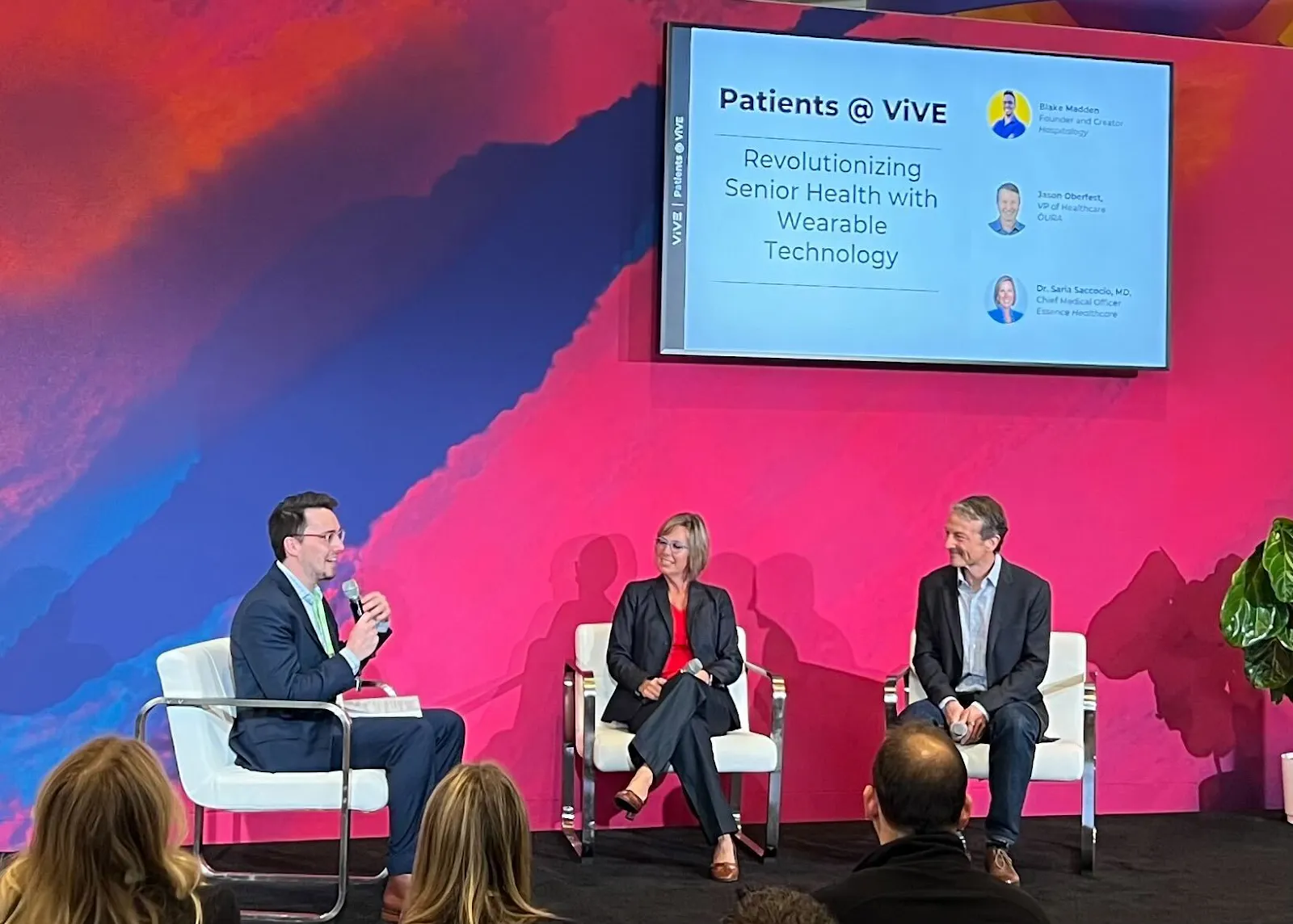
This send is coming live to you from ViVE!
Big thanks to those of you who stopped by Navina’s booth to say hi and chat about value-based care or college football, even if you aren’t rooting for Texas to be #1. Hospitalogy welcomes all takes (even the bad ones).
Photo evidence taken by my amazing Hospitalogy brand partner Keith Jayne:
|
This only makes me cringe a little… |
My New Years Resolution: Share more of the cool stuff Hospitalogy’s up to. In that spirit (and as I sprint to another session), I’m unearthing notes from three closed-door 1:1 conversations in the Hospitalogy community that have me excited about where the industry is going. |
|
|
Key considerations for decision makers. Notable moves, policies, and strategies |
Note: Sadly, these conversations were not recorded—I hope these highlights will do them justice. The good news is that moving forward, we’re recording and uploading roundtables like these to the community. That means current and future Hospitalogy members can re-watch anything they missed. Okay, onto the good stuff:
|
Back in November, I caught up with Jason Oberfest, Oura’s VP of Healthcare, to chat about their dive into traditional healthcare (at a cool $5B valuation):
-
Why a ring? They say that, unlike wrist wearables, its ring form factor offers more accurate readings from finger arteries, including heart rate, blood oxygen, and temperature.
-
Value-Based Care Partnership: Oura’s collaboration with Essence Health integrates wearable data into clinical workflows. Members can access Oura rings as a covered benefit, possibly aiding in detecting conditions like sleep apnea, which impacts 30 million Americans.
-
The #1 thing that surprised me: Contrary to expectations, Oura’s 65+ users are more engaged than younger generations. Future focus areas include managing GLP-1 weight-loss interventions, fertility tracking, and early illness detection for vulnerable populations.
|
Last fall, Aegis Ventures added UPMC and Vanderbilt Health to its consortium. I caught up with Cofounder and Managing Partner John Beadle to discuss how they’re tackling quality, equity, and cost.
- The Model: Aegis’s digital consortium unites 30+ health systems, sharing expertise to solve common pain points like care navigation that enhance (not replace existing services.
-
The Competitive Edge: I asked, “How can health systems stay competitive amid increasing consolidation?” John’s answer: Aegis thrives on a “by systems, for systems” approach; bringing together collective expertise to tackle navigation, call centers, and care gaps without stepping on existing services.
-
Looking Ahead: With heavyweights like Northwell Health’s Michael Dowling in their corner, they’re zeroed in on scalable, game-changing solutions in a crowded $80B digital health market. Excited to keep an eye on them.
|
I also sat down with David Koretz, CEO of Biofourmis + CopilotIQ, to dive into their big merger and hear what’s on deck for them.
-
The October Merger: Biofourmis and CopilotIQ has created the first AI-driven, end-to-end platform for in-home care. Their capabilities span pre-surgical optimization to chronic care management.
-
The Numbers: With 64M Medicare/Medicaid patients managing chronic conditions like hypertension and diabetes, the platform uses predictive analytics to optimize clinician-patient interactions and reduce hospital readmissions.
-
The ‘Aha’ Moment: Turns out, Hospital at Home and SNF (Skilled Nursing Facility) at Home programs demonstrate better outcomes, shorter stays, and lower readmissions, redefining post-acute care.
|
|
|
The marketing team at Nabla is hiring an Events Manager. We’re looking for someone with experience in healthcare events who excels at planning and executing industry conferences, building meaningful connections, and bringing our brand to life in person.
If you know someone who might be a great fit, I’d love an intro—or feel free to pass this along to your network! Here's the job posting.
|
Random personal anecdotes and musings from me |
|
|
Thanks for the read — stand by for my recap of ViVE 2025! Let me know what you thought by replying back to this email.
— Blake
|
|
|
|