It looks like you’re a Hospitalogy member but haven’t been receiving the newsletter. We’ve added you to make sure you get the full experience (and if you’d rather not get it, you can always update your preferences at the bottom of this email). |
|
|
Happy Tuesday, Hospitalogists!
The word “innovation” gets tossed around a lot in healthcare, but it’s pretty rare to feel like you’re actually getting a glimpse into the future.
I hope today feels a little like that. I’m giving you a peek into a company that got me genuinely excited about what infrastructure might look like in the hospital of the future, and the tech that could get us there.
As always, looking forward to your thoughts. Let's dig in.
|
|
|
The most important news from the week |
Recently, I had the opportunity to learn more about an emerging startup, Artisight, which specializes in AI-driven hospital infrastructure and offers a smart hospital platform built around computer vision, ambient intelligence, and edge AI.
You might remember Artisight from back in June when they raised $42 million in an oversubscribed Series B.
At the time, Dr. Andrew Gostine, the CEO and co-founder of Artisight, gave me a full rundown on Artisight’s plans for the hospital of the future. I can’t share everything here, but when I saw how smart cameras in ORs, patient rooms, and supply zones could annotate everything from scrub times and instrument movement, to how much food the patient ate and when a bed needed repositioning, I knew I had to come back and put them on your radar.
So, let’s get into what Artisight is doing and what the future of “smart” hospitals might look like.
|
Artisight started in a hospital, not a boardroom. In his first week back in residency, Dr. Gostine, a dual degree MD and MBA and former high frequency trading investor, was handed a pager and a fax machine. He had just come from a world where using technology to shave microseconds helped a firm earn $1B. But inside the hospital, care still ran on spreadsheets and phone trees.
At one point, Dr. Gostine wrote software that automated surgery scheduling at his hospital. But there was a much bigger idea brewing. If clinicians are forced to manually input everything, the hospital stays data poor. What if you rebuilt the hospital to automatically sense and capture the data on its own?
That question eventually led Dr. Gostine to team up with a lean manufacturing expert and a physicist focused on software and AI to attack real problems for health systems. The result was Artisight, a platform developed by clinicians for clinicians.
|
At its core, Artisight wants to build the infrastructure to make smart hospitals a reality.
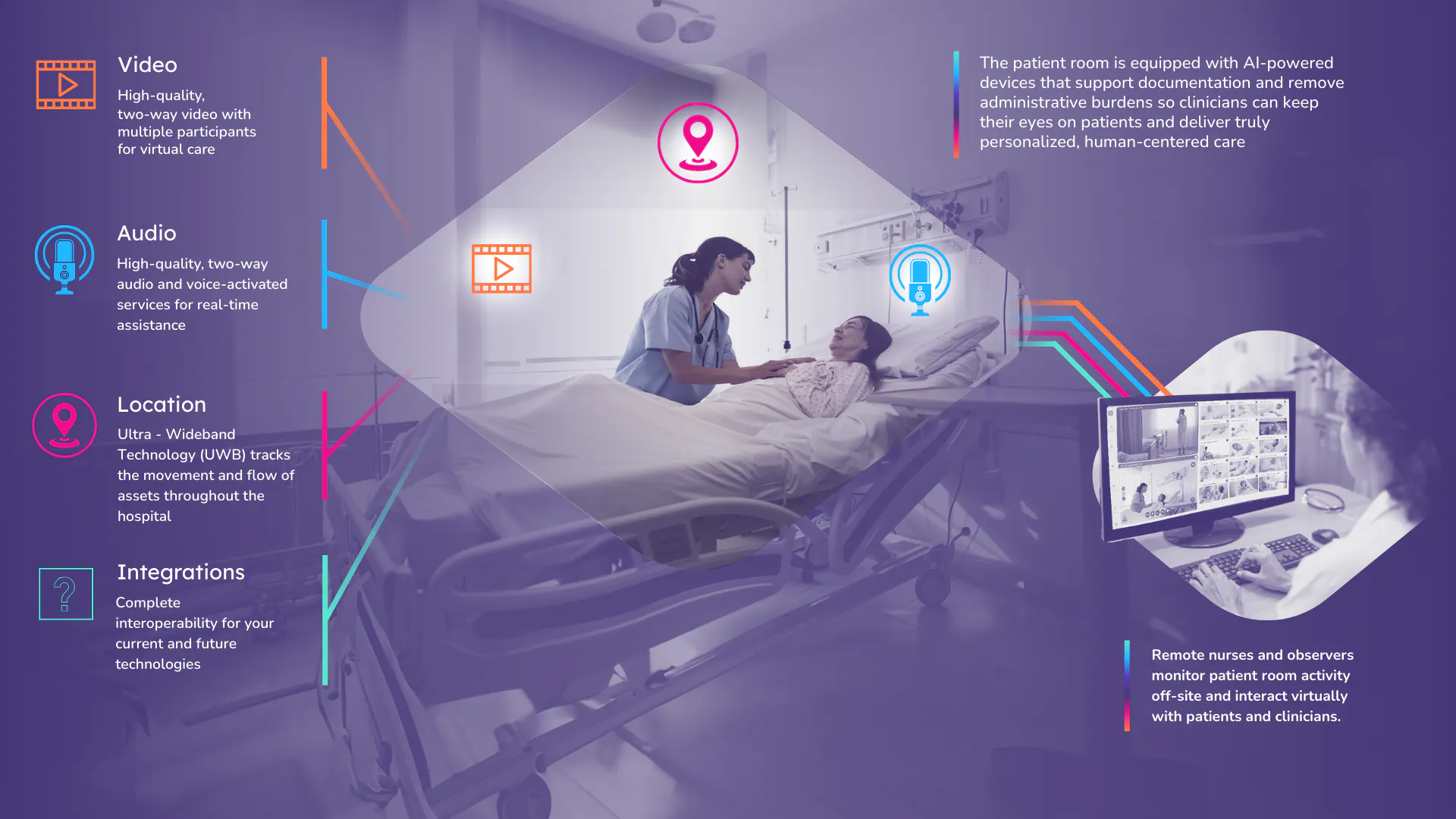
Artisight licenses its software and services to hospitals and health systems. Their platform acts as a central hub, integrating computer vision and a multi-sensor network with industry-defining AI, indoor positioning and real-time location systems, voice-activated services, video conferencing, and the hospital’s EHR and other third-party systems. Ambient intelligence learns and responds to a hospital’s exact environment and workflows, and is scalable to fit changing needs.
That means each room, whether it’s a patient room, OR, or even a supply closet, can be outfitted with compact, powerful devices that act as the “eyes, ears, and touch” of the system.
These aren’t just cameras. They’re NVIDIA GPU-powered compute devices capable of running AI models directly at the “edge,” i.e., within the hospital’s network and physical boundaries. This means no video streams leaving the room, no reliance on cloud processing (reduces latency), and much stronger data privacy and scalability.
With Artisight actively assisting teams, hospitals can ease clinician workload, enable virtual workforces and centralized nursing, lighten documentation burden, track and manage assets in real-time, and increase patient and OR throughput. They can also capture datasets for operational analysis, use insights to spot opportunities, and solve multiple pain points without needing multiple point solutions.
Sounds like a rosy picture, but they’ve got numbers to back it up. Here are some results reported by client Northwestern Medicine after implementing Artisight in patient rooms:
- 52% reduction in nursing overtime
- 89% reduction in patient falls
- 76% reduction in nursing turnover
-
Record-high nursing and patient satisfaction scores
|
There are three main components that make up the Artisight platform: Artisight Patient Room, Artisight Operating Room, and Artisight Clinic. I’ll focus more on the patient room and OR side of things for this spotlight. Here’s the breakdown: |
In patient rooms, Artisight’s technology makes seamless interactions and frictionless workflows possible with advanced audio-visual capabilities, ambient sensors, and real-time data capture. Here’s what their system enables:
-
Ambient documentation: Nurses no longer have to log into terminals or carry devices. They walk in, and the system identifies them via voice biometrics. They can dictate care updates out loud, see the transcript on the TV, confirm it’s correct, and it’s sent directly to the EMR. No clicking. No keyboards.
-
Virtual nursing, observation and collaboration: Bedside nurses can focus on care delivery as virtual nurses monitor and interact with patients, complete real-time documentation, and manage care plans. On average, Artisight clients experience a 64% reduction in virtual observer costs.
-
Fall prevention: The system can immediately alert staff if a high-risk patient attempts to get out of bed (fall risk) or if a critical alarm is ignored. A big differentiator: Artisight can distinguish between a patient and a provider, leading to far fewer false alarms and greater trust from nurses. (On average, Artisight clients experience an 83% reduction in falls.)
-
Greater staff and patient safety and well-being: Features can be deployed to reduce clinician burnout and improve patient and staff safety and well-being (e.g., virtual observations, bedside management, real-time location systems technology, staff duress alerts, pressure ulcer prevention).
-
Teleconsulting: Rounds on patients can be completed with a remote and an intuitive application that uses existing hardware and covers every type of televisit, including telehealth, eICU, telestroke, etc.
-
On-demand medical interpreter support: In late July, Artisight launched voice-activated interpreters on the platform so clinicians can seamlessly communicate with patients in hundreds of languages. Within seconds, the technology enables around-the-clock access to thousands of medical interpreters in more than 240 languages, including American Sign Language.
-
Performance and operational insights: Custom dashboards and analytics reports give leaders a clear view of their organization’s performance. Critical administrative data can be tracked across the facility in real-time, including the time a patient is in a room, how long it takes to clean a room, inpatient capacity, supply closet inventory, and loading dock receipts. Leadership can use the information to make informed decisions about workflows, operational efficiencies, inventory needs, and staffing needs. They can also unlock opportunities to optimize processes, improve care delivery, and maximize revenue.
|
In high-cost, high-throughput environments like operating rooms, where even small inefficiencies can cost hospitals millions, AI that understands the flow of surgery is a game-changer.
With Artisight, hospitals can deploy a full suite of features via cameras, a speaker, two-way enabled video, voice-activated sensors and CV technology in each operating room. Everything works together to ensure surgical teams have the precise, up-to-the-moment information they need to be as efficient as possible, keep surgeries running smoothly and on schedule, enhance perioperative efficiency, better avoid “never events,” and ultimately increase surgical volume.
Artisight’s OR platform offers:
-
Video recording of surgeries: Surgery Viewer can capture videos of surgeries while ensuring HIPAA compliance. This feature removes PHI and converts videos into educational tools for surgical teams, residents, and interns. Teams can edit, add digital annotations, and download and archive the final videos all within the Artisight platform.
-
Computer vision-based surgical phase recognition: Artisight’s platform can detect specific surgical actions (e.g., patient entry and exit, procedure start and end time, and other key milestones in a patient procedure).
-
Ambient timestamping and documentation: Artisight autonomously detects milestones, and timestamps these directly into the EHR.
-
Vital data capture: Everything from supply usage to hand hygiene compliance to the movement of beds and surgical drapes is tracked passively. This OR data is captured in real time and fed into the EHR so utilization can be measured and insights into the effectiveness of OR workflows and adherence to discharge standards and PPE compliance can be gained.
|
Outpatient clinics are another key part of the hospital ecosystem that’s often neglected when it comes to digital transformation. Clinics benefit from real-time patient map and location alerts, passive check-in and check-out, patient flow analytics, clinic equipment and supplies tracking, telehealth visit management from a single platform, and more. |
Additional reasons to keep Artisight on your radar:
-
Since I spoke with Dr. Gostine, Artisight has been moving lightning fast. In late August, the company announced it was the first smart hospital platform capable of autonomously documenting operating room activity into a patient’s EHR using advanced AI and computer vision.
-
This is a proven platform, already deployed at scale (today, Artisight is used in over 425 hospitals across 30 health systems), and now expanding rapidly with a clear growth trajectory.
-
Artisight has tight integrations and partnerships, including leading EHR players.
-
Fundraising rounds have been very successful, including full participation of Series A investors in the Series B funding round (including NVIDIA), a show of continued support.
-
While there are some drawbacks to being a smart hospital, such as technology cost, extensive implementation, and the idea that some staff and patients may be opposed to camera use, Artisight is proactive in ensuring the exposure of PHI does not have to be a concern. As stated in Artisight’s privacy policy, Artisight software “does not store any images, video, or audio with protected health information, links to individual patient records, or searchable tags… No PHI is used in the creation of algorithms. No PHI is stored by Artisight’s systems.”
Based on what I’ve seen so far, Artisight is building scalable infrastructure, with real AI firepower that solves real problems for hospitals. Check them out and let me know what you think!
|
|
|
My favorite reads & resources from the week |
*This read is brought to you by one of my brand partners who help make this newsletter possible!
|
|
|
Thanks for the read! Let me know what you thought by replying back to this email.
— Blake
|
|
|
|