
The Gen Z nurse retention cliff
In partnership with

Hospitalogists,
Every few months, a new "Gen Z in the workplace" report lands in my inbox, and most of them read like a bunch of Gen Xers grumbling about kids these days. But the latest Insights report from the American Organization for Nursing Leadership (AONL) and Laudio Insights is different. It’s refreshingly aware of the generational zeitgeist without getting caught up in it, and jam-packed with insights into why Gen Z RNs leave right when you think you’ve got them.
This one's worth putting in front of your CNOs and nursing directors especially, but the financial stakes make it just as relevant for COOs and CHROs.
A personal thank you to Laudio for sharing the data behind this one. Here's my take.
BLAKE'S BREAKDOWN
The Gen Z Retention Cliff: What 100K RNs Are Telling UsCopy anchor linkCopied
For their latest report, Engaging and Retaining Gen Z Nurses: Trends and Strategies, AONL and Laudio Insights pulled data from nearly 100K RNs across 150+ hospitals and health systems, paired it with interviews from 15 nurse executives and managers who've figured out how to retain Gen Z talent, and let the numbers do the talking.
Let's start with the cost and retention stats around RNs in general. National RN turnover sits at 17.6%, ranging anywhere from 7.6% to 33.1% depending on hospital size and geography. The average cost of turnover for a bedside RN is $60,090, with the average hospital losing between $4.2M - $6.2M per year to RN churn.
While it’s obvious you need to retain your RN workforce, you’re likely missing an essential fact in your approach: the makeup of your workforce is quickly changing, and your retention strategies must change with it.
Your retention playbook is older than your workforceCopy anchor linkCopied
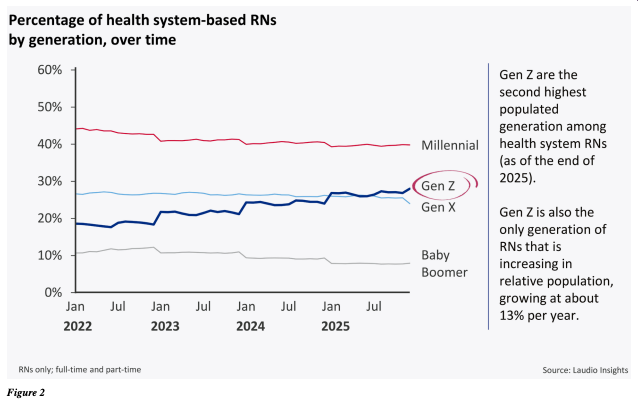
Gen Z is now the fastest-growing segment of the nursing workforce and the only generation gaining share. They’re also approaching the 30% "tipping point" where they start setting the culture instead of adapting to it. And think about this: as the oldest Gen Z RNs begin moving into leadership roles this year, they're positioned to redefine the norms of nursing itself.
This means engaging and retaining Gen Z nurses is more than an HRA topic. It's a straight line to your growth, quality, and patient experience goals. You're not hitting any of those without getting this right. And you’re not getting this right if you’re carrying over your retention playbook built for millennials and Gen X as-is.
Gen Z operates differentlyCopy anchor linkCopied
Here are 4 things worth taking away from this report:
- Gen Z nurses need 2.5x the "meaningful interactions" (and up to 5x compared to the oldest Gen Xers). Three documented, work-related touchpoints per quarter move the retention needle for Gen Z the way one touchpoint does for a Baby Boomer or Gen X RN. Traditional retention levers such as annual reviews and standard onboarding simply aren't calibrated for this generation. Managers need shorter, more frequent check-ins built directly into the workflow.
- The early years are well-structured and supported… then comes month 30. Gen Z has the strongest early-tenure retention of any generation, thanks largely to residency programs and structured onboarding. But once that formal support ends around the 30-month mark, Gen Z turnover flips to exceed millennials and Gen X. The data points to a heightened turnover risk tied directly to when sustained engagement ends.
- Gen Z has genuinely distinct expectations, and the data backs it up. Gen Z nurses want manager connection, flexible communication, and visible career growth from day one, not five years in. This isn't the usual "kids these days" narrative. It's a statistically significant finding, and it means the strategies that engaged prior generations may not be enough for this one.
- The report hands leaders an actual roadmap, not just a diagnosis. Five executive priorities emerged from the interviews: personalizing professional development, adapting organizational structures and systems, modernizing communication, prioritizing wellness and flexibility, and advocating for mental health. Get these right, and you reduce costly turnover, stabilize your workforce, and protect the patient experience and care quality that depend on a stable bedside workforce.
The bigger theme: this isn't a story about one generation's quirks. It's a data-driven call for creating a workforce model built for a different era finally meeting a cohort unwilling to tolerate its friction. The health systems that adapt first are going to have a significant competitive edge on retention.
Check out the full report here. Big thanks to Laudio for putting real data behind a conversation that's mostly been vibes until now. This topic and much more will be discussed at LINE, Laudio’s annual, invite-only conference in Boston, October 5-7, that gathers health system executives to discuss key challenges around workforce operations.
Thanks for the read! Let me know what you thought by replying back to this email.
— Blake