
The Next Healthcare Advantage Isn't More Data. It's What Happens Next.
Same Login Rates, Very Different Results
Sponsored by: NRC Health

Across its solutions, NRC Health helps healthcare organizations turn what they know into what they do next.
See More HereHealth systems are investing heavily in AI, analytics, digital transformation, and tech that promises operational intelligence. But if they aren't using the insights these generate to turn intelligence into meaningful, repeatable operational improvements, they're missing a key competitive advantage.
This point is made clear by a new nSight report from NRC Health, a healthcare experience improvement and consumer intelligence company that helps health systems listen to patients, consumers, employees, and communities and act on what they learn. The report, From Signal to System: Experience Management Everywhere, and its findings deserve a spot on the C-suite's reading list. Here's the TL;DR:
- In NRC Health's analysis of 376 partner organizations, high performers used the platform about as much as everyone else. What set them apart was what happened after the data arrived.
- The report suggests a framework, Experience Management Everywhere (EME): five interconnected responsibilities (Align, Listen, Act, Build, and Evolve) that span the whole organization, not a single department.
- Patient and consumer experience is a business strategy. It can reveal opportunities to improve access, strengthen loyalty, and reduce operational friction, but only if it reaches people who can act on it.
Same Login Rates, Very Different ResultsCopy anchor linkCopied
NRC Health compared 41 high-performing organizations, identified through strong patient experience performance, with 335 other partners. On platform use, the two groups looked nearly identical: 6.2 active users per 100 clinicians for high performers vs 6.1 for everyone else. The gap showed up in what those users did next:
- 98% of high performers closed service alerts vs 80% of other organizations
- 2.01 alerts closed per active user vs 0.63, more than 3x as many
- 21.4% of active users participated in alert closure vs 12.5%, so the work was more widely distributed
- 85% with at least 1 clinician summary subscription vs 57%, with a median of 2.41 subscriptions per active user vs 0.36
The researchers are upfront that this is observational. Those measures don't necessarily show whether information is reaching the right people, influencing decisions, or changing workflows. For example, closing an alert doesn't mean the underlying issue was resolved and a report subscription doesn't tell us whether someone read a summary or changed behavior. But what the data in the report does show is a pattern worth testing in your own organization: high performers used the platform about as much as everyone else, but did more with what it told them. The open question is what the rest of the field could gain by closing that gap.
AI Widens the Pipe. Someone Still Has to Build the PlumbingCopy anchor linkCopied
NRC Health's argument is that this matters more as AI gets better at surfacing insights. When it's faster and easier to pull an answer out of the data, organizations that haven't solved the insight-to-action problem will generate more information without seeing proportionate improvement.
In a webcast on the findings, William England, Ph.D., the report's author, described the fix as moving from signal to system. A signal is a survey response, an employee comment, a rounding observation, or a service alert. It becomes part of a system when someone has decided who sees it, who changes something because of it, who has the authority and resources to act, and who determines whether the action made a difference. As the report puts it, getting data isn't the hard part anymore; the hard part is "turning what you know into what you do."
That puts a different test on every tool in the stack. It's not just does the tool work. It's does it make it easier for an employee to do their job, solve a problem, and improve care.
Five Responsibilities, One OrganizationCopy anchor linkCopied
To make sense of what high performers do differently, NRC Health built its Experience Management Everywhere (EME) framework around 5 interconnected responsibilities:
- Align: Connect experience improvement to organizational goals and leadership accountability.
- Listen: Look beyond traditional experience surveys to understand patients, consumers, employees, and communities.
- Act: Make sure feedback reaches the people who can address problems.
- Build: Make listening and improvement part of everyday workflows rather than separate initiatives.
- Evolve: Continuously test, learn, and adapt as patient expectations and organizational needs change.
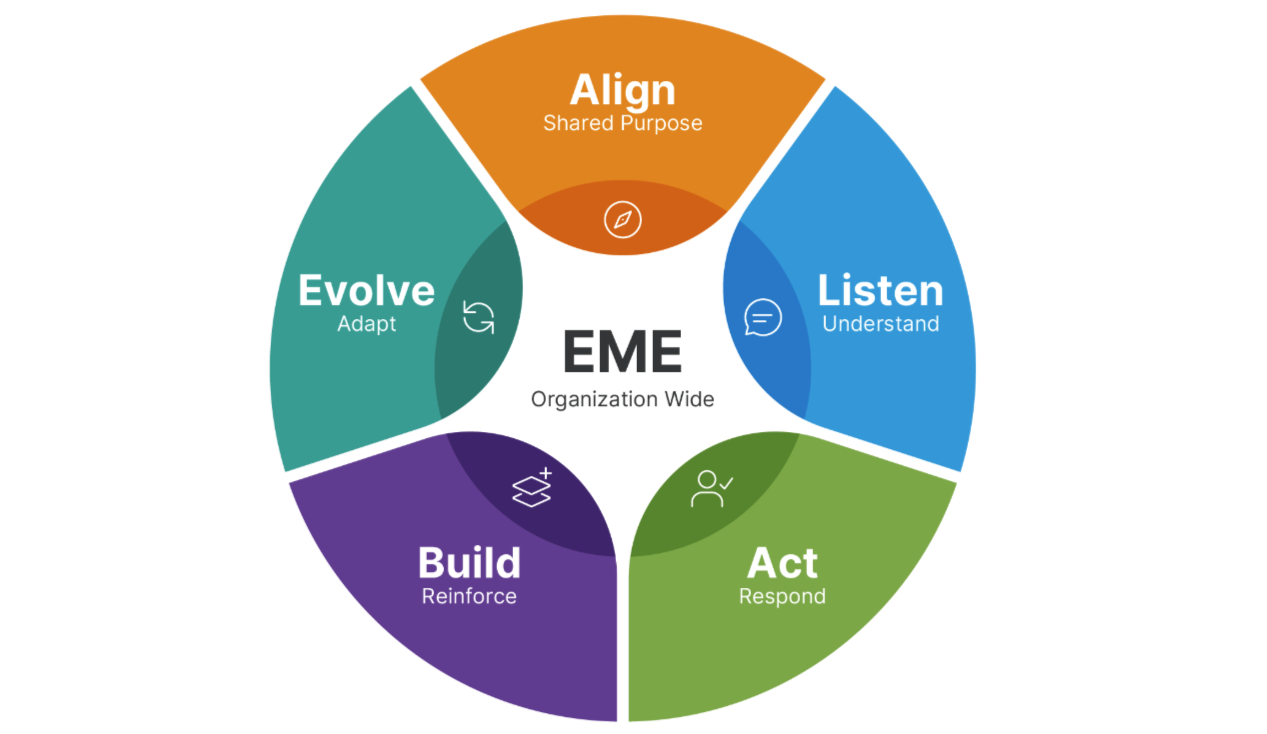
The framework isn't a maturity ladder. Organizations can enter from different points: listening may reveal a problem that requires new alignment, and action may expose a workflow issue that requires a new process. That interdependence is the point, and it's why no single dashboard or technology purchase covers it. NRC Health's position is that experience management can't live in a single department.
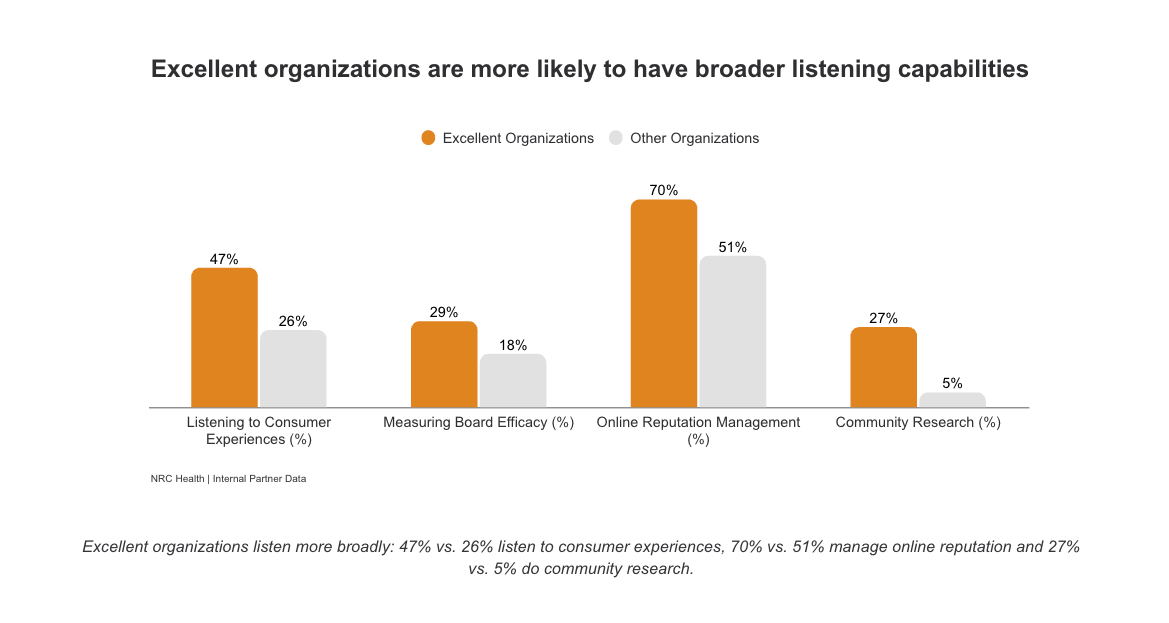
The differences NRC Health found are also about leadership choices. Among organizations with documented goals, 49% of high performers referenced key drivers of patient loyalty, such as trust and communication, vs 26% of others. Nearly 88% had documented C-suite interactions with their NRC Health account team vs 36%, though NRC Health notes that may partly reflect differences in account documentation. High performers were also more likely to go beyond surveys to other measures of consumer experience (47% vs 25%), and more likely to listen to consumer experiences themselves (47% vs 26%). 27% went beyond traditional patient experience measurement with targeted community research vs 5%.
In a related post, Excellence Isn't Accidental, Jason Messerli, a strategic advisor at NRC Health, names 3 ways organizations stall on action: analysis paralysis, the hunt for a silver bullet, and negativity bias, where recognition gets less rigor than the grievance process. He adds that the best practices rarely differ from one top performer to the next. How well an organization socializes, teaches, and uses its tools to make those practices stick is what differs.
One Scheduling Form, 270K ResponsesCopy anchor linkCopied
Also in the webcast, Jon Tanner, an NRC Health product leader, shared a good example of an organization connecting aspects of the EME to their daily work. About six months ago, an NRC Health partner began collecting feedback specifically about scheduling experiences in addition to feedback about completed visits. In that time it sent about 3M surveys asking about scheduling satisfaction and heard back from about 270K people, including whether they had booked a visit in an office, through the contact center, or through digital tools.
About 5K of those respondents raised a hand through an alert because they couldn't get an appointment scheduled, and all 5K alerts were forwarded to the appropriate parties to call them back and help get the visit booked. That's service recovery, but it's also access. As the product leader noted, it's a revenue question too: keeping those patients connected to the health system and getting the care they need.
Then an interesting comparison was made. Feedback on scheduling through the patient portal was 60% positive, vs 82% through the contact center. Digging into the why, the partner found that much of the portal's negative feedback came down to a lack of available appointments. The portal listed physicians by star rating first, and the most highly rated physicians often had no availability. The partner switched the display to surface physicians with availability first, regardless of star rating.
Run that through the EME framework and several responsibilities show up. Listening extended beyond the visit to the scheduling moment. Action meant getting 5K alerts to people who could call patients back. Building meant changing how appointments are displayed, which is a workflow fix, not a dashboard. And evolving means the partner is now testing an AI agent in the contact center, against a baseline of 82% positive feedback.
Where NRC Health FitsCopy anchor linkCopied
NRC Health's experience improvement solutions are built around the path from signal to action.
Across its solutions, NRC Health helps healthcare organizations turn what they know into what they do next. That means giving frontline teams what they need to improve patient experiences, helping leaders anticipate changing consumer needs, strengthening trust and visibility as people choose care, supporting the people delivering that care, and equipping boards to make better decisions for what’s ahead.
Jon Tanner said the company builds its products on the idea that information should be pushed to the frontline in a way that's easy to act on. That philosophy shows up in the products themselves. Tanner shared AI-suggested responses, for example, can reduce service recovery from a 10- to 15-minute activity to a 15- to 20-second one. On discharge calls, NRC Health reviewed hundreds of thousands of nurse follow-up notes from 15 years of calls and found that only about 27% would have required a nurse or clinician to follow up. About 35% were administrative or pleasantries, and about 34% were logistics. The direction NRC Health is exploring is getting the right alert to the right person right away, and taking the rest off a manager's plate.
NRC Health is thinking beyond measurement. Understanding how an organization is performing is table stakes. The broader approach asks what has to happen across the organization for performance to improve.
The Advantage Is Follow-ThroughCopy anchor linkCopied
Long story short, I think NRC Health is pointing at the right problem. Patient experience (along with consumer, employee, and consumer/market intelligence) is a business and revenue strategy. Follow-through (having the tools, leadership engagement, and processes to consistently turn intelligence into better experiences) is the competitive advantage.
NRC Health is candid that none of these actions are new to leaders. Execution is where most organizations get stuck. Where does the output go once it lands, who owns what happens next, and how do you know it worked? For a closer look at the research, read the full report. To see how NRC Health helps organizations capture feedback and act on it, explore its patient experience management solutions.