

Here’s the TL;DR:
- AI is a megaphone for bad data. Only 14% of healthcare leaders say AI insights are fully integrated at their key decision points, and 85% of health plans still haven’t centralized their data. Every agentic pilot that stalls in 2027 will trace back to a data foundation nobody fixed.
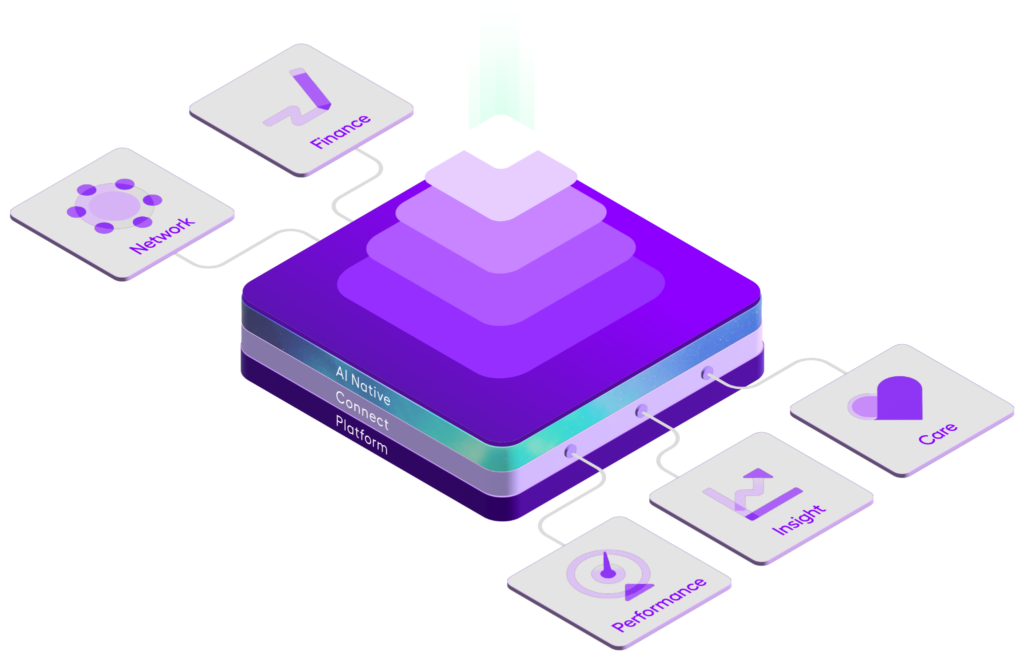
- Arcadia spent 20 years building that foundation, and this month it introduced its system of intelligence. Arcadia Ascent™ unifies clinical and claims data across every EHR and payer feed in an enterprise, then layers 5 modular solutions on top (Care, Performance, Network, Finance and Insight), with AI embedded on a gradient of autonomy that your governance controls.
- The ROI is hard, not hand-wavy. Guidehealth moved every quality-focused customer from 1 or 2 Stars to 4 or better and pegs the gap-closure work at a 3:1 return. Samaritan Health Plans cut a monthly provider-reporting job from 120 to 160 analyst hours down to 16 to 24. Rush Health pulled $19.8M in Medicare ACO cost savings on a 97% quality score.
- Your EHR is the system of record and the system of action. It was never designed to be the system of intelligence. Arcadia is built to be that layer on top of Epic or any other EHR, and the two coexist better than the discourse suggests.
If any of that sounds like the 2027 plan sitting on your desk, get in touch with the Arcadia team and tell them what you’re trying to fix.
I first met Arcadia’s CEO Michael Meucci at HLTH a couple of years ago, back when half the booths on that floor were selling “AI-powered insights” on top of data they didn’t have. Arcadia was the opposite problem: a company with more data than almost anyone in the building and a story the market had filed under “population health analytics” and stopped reading. Since then I’ve followed the CareJourney acquisition, the Nordic Capital majority investment, and a steady drumbeat of partnerships and launches, waiting for the moment the story caught up to the asset.
If you’ve been reading Hospitalogy for any length of time, you know Arcadia as the platform that swallows a health system’s dozen EHR instances and its payers’ claims files and produces a longitudinal patient record clean enough to run a Medicare ACO on. Johns Hopkins, the American College of Surgeons, Aetna, Blue Shield of California, the California Department of Health Care Services. 20 years of that…and most of the market still thinks of Arcadia as a point solution.
What you may not know is that Arcadia has spent the last 2 years quietly rebuilding itself around a different idea, and this month it stopped being quiet. Arcadia Ascent™ is a healthcare performance platform, a system of intelligence that sits on top of your system of record and turns a fragmented patient record into a comprehensive one you can act on. More than 50,000 stakeholders serving 150M+ lives already rely on Arcadia’s intelligence across provider, payer and life sciences organizations. And they’re just getting started.
Here’s the Arcadia thesis: the next 5 years of healthcare technology belong to whoever owns the trusted data layer, and Arcadia has a 20-year head start. 3 reasons:
- AI is only as good as the record underneath it, and Arcadia’s entire business is the record.
- Nobody else convenes payers, providers and life sciences on a single source of truth, which is where the friction (and the money) in value-based contracts actually lives.
- Arcadia co-develops with its customers. Ochsner built the finance solution with them. Guidehealth beta-tested the care solution. So the roadmap gets written by operators, which is rarer than it sounds.
Now, the timing. Every health system has an AI strategy in 2026. Far fewer have a data strategy underneath it. Arcadia’s own survey of 281 healthcare leaders at HIMSS26 found that 52% believe AI can fundamentally transform healthcare when applied correctly, and 14% say AI insights are fully integrated at their key decision points. Read those two numbers together. On the payer side, 85% of health plans haven’t integrated all their available data into a centralized analytics platform. So the foundation is getting built one way or another, either deliberately this year or expensively after the third pilot stalls. It’s no longer optional.
So you might as well build it with the company that has been doing the unglamorous data plumbing since 2002, and just turned 20 years of it into something you can run an enterprise on.
AI is a megaphone for bad data
Meucci has been at Arcadia since the beginning, and the founding problem statement hasn’t moved: change people’s lives with data. He’ll tell you healthcare has the most challenging data foundation of any industry, that it was true 20 years ago and is truer today, because cell and gene therapy, precision medicine and better diagnostics all generate more data than the systems underneath them were built to hold. He is also, by his own description, “practical to a fault.” No origin story about a sick relative. He looked at a sector that was 20% of the economy and decided that was a reasonable place to point some effort.
That practicality shows up as a refusal to pick a camp. When we talked, he reached for Dickens: best of times, worst of times. On one side, GLP-1s, cancer drugs that work and curative therapies that extend life by decades rather than years. On the other, hospital margins only now recovering to pre-pandemic levels, payer EBITDA pools at the worst levels he has seen, and access getting worse. Two colliding worlds, and most healthcare commentary picks one and lives in it. Meucci refuses, and it makes him a lot more useful to listen to than the optimists or the doomers.
Then he gave me the most candid answer I’ve gotten from a vendor CEO all year. Every year before Aggregate, Arcadia’s user conference, he hosts a closed-door Executive Leadership Forum for 1 or 2 executives from every customer. Last year he walked them through the macro slides: healthcare headed toward 30% of GDP by 2035, defense spending crowding out health spending, demographics running the wrong direction. Afterward a longtime customer asked him whether value-based care and alternative payment models were going to be the thing that got healthcare spend down to 13% or 15% of GDP.
“F*** no,” he said.
And then he went into the wilderness for a while. He and his co-founder Nick Stepro take a trip together every year, and this one turned into a referendum on whether he’d spent 15 years building a company that couldn’t fix the biggest problem in the industry it serves. He came back with 2 conclusions from his personal Walden.
1st, what Arcadia built is real, because customers have told him the platform surfaced comorbidities and drug interactions the EMR never showed and saved lives doing it.
2nd, value-based care alone is not going to bend the cost curve in any material way, so the company had better point itself at the thing that will.
And that thing is the transactional costs of healthcare. We spend roughly $1.5 trillion a year on healthcare administration in this country, about the combined healthcare budgets of France, Italy and Germany. A healthcare transaction carries a 20% to 23% cost. Compare this transactional cost to tapping an Amex, the most expensive card in your wallet, which costs about…3%. Visa and Mastercard run closer to 2%. And roughly 100,000 nurses in the United States do nothing all day except process prior authorizations, sitting between a payer and a provider arguing about whether a case meets an LCD or a Milliman guideline.
What a fantastic use of a nursing degree in the middle of an access crisis. (This is /sarcasm, for you folks in the back).
Meucci’s answer to the obvious objection (you want to put 100,000 nurses out of work?) is the stenographer pool. When word processors showed up, the people who typed memos didn’t vanish, they got redeployed into higher-skill roles, and he’ll argue it was one of the great accelerants for women in the workplace. That’s the opportunity he sees for the administrative layer of healthcare, and it’s why Arcadia sought investment from Nordic Capital last year: to make the admin cost the enemy.
Which brings us to the line Arcadia’s own marketing team has heard him say a hundred times. AI is just a megaphone for bad data. He watches payer and provider executives and founders ignore the fact that you cannot put AI on top of a fax machine, and he thinks it’s the critical error of this cycle. Arcadia’s job is to be the trusted intelligence layer: the place you deploy your AI, the insights engine that tells the voice agents and ambient scribes what to go do, and the adjudication layer that asks whether those solutions are safe, responsible and delivering what they promised.
He also thinks in ROI, which I appreciate. Trillions spent over 50 years, and by the McKinsey Health Institute’s count we’ve added 4 months of healthy lifespan. “If I was a banker or a private equity person, I would yank funding from healthcare.” As a recovering valuation guy, I laughed at that, and then I stopped laughing considering the profession and industry I chose. Maybe I’m headed into the wilderness next.
Meucci’s own scorecard for Arcadia has moved based on Arcadia’s evolution. 3 or 4 years ago success meant systems connected and quality measures calculated. Now the questions are whether a customer doubled the number of patients under care management with the same staff, whether wait times for a new appointment came down, and whether that customer is the outcomes leader in its market. Real-time adjudication at the point of care, in his view, is the whole ballgame. His Amex has a chip in it and works anywhere. His insurance card has a fax number on it, and booking an MRI took him 3 hours.
That is the company. Everything below is the product.
AI is Excel, and you don’t hand a new hire the keys on day one
Chris Rallo joined Arcadia as Chief Product Officer at the end of March, and his path there was nonlinear by his own description: finance, then consulting, then founding a company, then the better part of a decade at Amazon working from the consumer side over to AWS. His last 2 years there were spent building agentic products in healthcare, including the strategy and execution behind what is now Amazon Connect Health. So he arrived with a hyperscaler’s toolkit and a hyperscaler’s scar tissue.
But even with AWS-scale resources, the structural problem was a lack of data. His teams spent enormous effort training systems to do things that sound basic, like identifying a patient inside a call tree, scheduling an appointment, or refilling a medication, because the system had to infer what action to take and then prove the inference was right. What Rallo saw in Arcadia was a company that already knows what action to take, with which patient, at what time, because it sits at the intersection of providers, payers and life sciences and holds the longitudinal record on all of them. “It fills the gap I’d identified at AWS,” is the short version. With that as the wind in the sails, product effort can go into the experience instead of the guessing.
He has talked to about 25 customers since he started, and he spends most of that time on what they like least, because that’s the roadmap. What they like most is, plain and simple, consistency. Blocking and tackling: Arcadia aggregates all of the data on their populations, merges clinical and claims, enriches it, and puts capabilities on top that make it actionable, all on one platform. Trust came up in customer conversations too, unprompted, along with the ability to influence what gets built and when. What they want is also consistent, and it’s the number one topic in every conversation: do more with less. Thinner margins, sicker populations, growing panels, the same headcount. Rallo was hired to change Arcadia’s direction on exactly that problem.
Rallo’s thoughts on AI to date are pretty interesting, characterizing it as a paradigm-shifting product like Microsoft Excel: “It’s a very powerful tool, but it’s a tool nonetheless.” Applied incorrectly you get bad output, and there are workflows a leader should not delegate to a non-deterministic process no matter how good the demo looked. In healthcare specifically, humans stay at the center as the rule, and agentic flows get introduced in tiers: assistive, then supervised, then autonomous. He compares it to onboarding a new hire. “You wouldn’t just give them the keys to the kingdom out of the gate.” Autonomy gets granted as the empirical performance data accumulates and the customer’s comfort grows, and the underlying capability never changes. What changes is how much responsibility the software carries and how much oversight the human keeps. And Arcadia waited on purpose before embedding AI across the platform so that every function would work off the same context set and the same data, rather than bolting a chatbot onto one module.
His example is risk and quality, where Arcadia already has capabilities to find gaps and engage patients on the front end and to equip coders on the back end. But then two problems arise: those surfaces grew up disconnected as the company scaled, and they still require humans to log in and do the boring, repetitive, undifferentiated work. So then his team got to work on building end to end workflows. Before a visit, the 30 to 60 minutes a care manager spends assembling records and typing a summary becomes a synthesized pre-brief delivered inside the EHR, telling the clinician which risk and quality gaps to pressure-test during the appointment. After the visit, a chart review capability sitting on Arcadia’s document processing service acts as a retrospective coding agent, showing coders exactly where each diagnosis lives in the record with the evidence attached, which shrinks the retrospective claims work that today happens months later. No second screen, no chair swiveling. CIOs care a LOT about that.
That machinery extends outside the four walls. Karen Thomas-Smith, Arcadia’s Chief Marketing Officer, reminded me of the agentic teammates that call off-hours to schedule warehouse workers who can’t pick up during a shift, so the care managers spend their time on the conversation instead of the phone tag. On medication adherence, an agent handles “when is the best time we can call you?” with a human still in the loop, and one customer’s gap closures added half a point to its Medicare Advantage Star rating. Add it up and the ambition is care management for everyone on the panel, not just the top 10% your current staffing model can reach.
I also asked Rallo what Arcadia’s design philosophy is under his helm, and it’s delightfully simple: work backwards from the customer, shamelessly borrowed from his former employer. His product managers spend at least a third of their time with customers, and he considers that non-negotiable. “Product is not sitting behind a computer screen. Product is in front of your customers.”
Where healthcare differs is in pace. Outside of healthcare and finance you can push hard on fundamental changes to how users work. Here, the industry is behind on adoption and the operators have to be brought along. “We have to have a two-putt or a three-putt to get there.” (And you thought there wouldn’t be a golf reference in here). Incrementalism, change management reign supreme. This matches what I hear from executives constantly: people and process are the bottleneck, not the technology, and a Silicon Valley lens on healthcare workflow ends in a lot of unused software.
Work with a product team that spends a third of its time in your building. Arcadia’s does.
Meet Arcadia Ascent. The platform, plus the Legos on top.
All of that listening, co-development and wilderness time landed this month, when Arcadia went to market with Ascent and an evolved brand. It’s the culmination of the CareJourney acquisition, the Nordic Capital investment, and a candid diagnosis of the company’s own marketing problem: the market perceived Arcadia as a point solution, it was never clear how to get the most out of the platform, and whole capabilities (an entire contract management solution with actuarial expertise and forecasting, for one) existed without the industry knowing they were there. So Arcadia simplified the roadmap and the story into 3 solution families:
- Arcadia Ascent™, a healthcare performance platform that unifies trusted data, core analytics and workflow intelligence into a single source of truth for performance.
- Arcadia CareJourney™, the market and network intelligence business: referral patterns, provider performance, network optimization and benchmarking against 100% of Medicare fee-for-service claims.
- Arcadia LifeScience, which turns longitudinal clinical and claims data into real-world evidence and connects eligible patients with emerging therapies and trials.
This piece is about Ascent. You can think of Ascent as a foundation and then a set of Legos. Its foundation is the Ascent Platform itself, the unified data and performance backbone, and Ascent Connect, the interoperability layer that moves trusted data in and out of your systems and partners, including real-time ADT for intervention on admissions and discharges. What the foundation delivers is the stuff finance people lose sleep over:
- earlier visibility into downside risk exposure,
- fewer reconciliation surprises,
- standardized and audit-ready VBC reporting,
- faster time to insight, and
- a lot less spreadsheet dependency.
First insights arrive within 24 hours of partnership, by Arcadia’s count. Getting to insights everyone trusts takes longer, as Samaritan Health Plans will tell you below, but the 24 hours is where the conversation starts.
Then the Legos: 5 modular solutions on top of that foundation. Adopt what you need now, add the rest as you go, all off the shelf and configurable rather than bespoke:
- Ascent Care is the care navigation solution built to operationalize whole-person care. Care teams coordinate around shared workflows, and the outcomes it’s measured on are care manager productivity, fewer missed RAF opportunities, fewer avoidable ED visits and financially traceable impact. Guidehealth beta-tested it (more on that below).
- Ascent Performance covers quality and risk: HCC recapture, quality gap closure, Stars and HEDIS performance, chart abstraction and retrospective coding workflows, with higher chart review throughput and lower cost per chart without adding FTEs.
- Ascent Network is the network design and referral alignment module: keepage rate, lower low-value specialist utilization, lower observed-to-expected cost variation.
- Ascent Finance is the finance and contracting solution co-developed with Ochsner. Earlier visibility into contract performance, forecasting, contract structuring, MLR stability, and in-year course correction instead of year-end surprises.
- Ascent Insight is the analytics, IT and IS layer: enterprise data management, governance and advanced analytics, including the conversational analytics that let a curious C-suite answer a question without waiting on the analyst team.
AI is woven through all of it on the gradient Rallo described, assistive to supervised to autonomous, and it is not a black box. Arcadia’s models and analytics are transparent and clinically informed, and the automation dial sits with your governance committee rather than with the vendor. That distinction matters more than it sounds. A documentation task and a care escalation decision are not the same kind of risk, and a platform that treats them the same way is going to get somebody fired.
One more thing a policy-fluent buyer will appreciate. In healthcare your biggest customer also writes the rulebook, and Arcadia has built a real muscle for translating it: a decision matrix on whether to stay in MSSP or move to LEAD based on your own performance, an ACO customer whose comfort with its claims data let it spot an anomalous spike in skin substitutes that fed into a $30M Medicare fraud finding against a Utah practice, and a platform strategy that lines up neatly with where CMS is pushing on interoperability. Fraud, waste and abuse is the topic of 2026. You want the vendor that already caught some.
Now the Epic question, because you were going to ask. Arcadia’s own framing is the most reasonable I’ve seen a vendor put in writing: an EHR is not the wrong foundation, it’s the wrong finish line. Epic and every other EHR is built to be the system of record and the system of action, where care happens, where the legal record lives, where clinical workflows run, and none of that is going away. But no EHR, no matter how dominant, is designed to be the system of intelligence for an entire enterprise. A typical Arcadia customer pulls data from something like 16 EHR instances plus payer feeds, which means even a fully standardized Epic environment cannot see the whole patient on its own. Breadth inside one EHR is not the same thing as depth across an enterprise’s full data and analytics needs.
Meucci’s version of the argument is the travel industry. 30 years ago you got an airline ticket from a travel agent clicking at a green screen, and what they were clicking on was Sabre. Sabre still exists, and it is still the back end of every airline ticket you buy, which is why your record locator is 6 characters. What changed travel was consumerism: Travelocity and Kayak were front ends on Sabre with better design, and then the airlines built their own apps. He thinks healthcare goes mostly headless within 5 years, pushed along by ONC’s open standards and API requirements, and he thinks that’s the right outcome. Some systems will be Epic-first, with Epic as 1 of 3 or 4 platforms. Others will treat the EHR as a great transactional database and build their own consumer, employer and patient experiences on top. Both are fine. Both still need an intelligence layer.
I’ll add the honest version, because I have plenty of opinions about Epic’s platform power and this isn’t the place to prosecute them. Epic is a great system of record. It is moving faster than it has ever moved, and Meucci’s read is that competitive pressure will make Epic better along with everyone else. Its customers, who have sunk billions into it, are the ones demanding it do more, and that’s a legitimate market signal. None of it changes the arithmetic of a patient whose record lives in 16 places.
Epic is the system of record. Ascent is the system of intelligence. Run both.
Where the ROI actually shows up
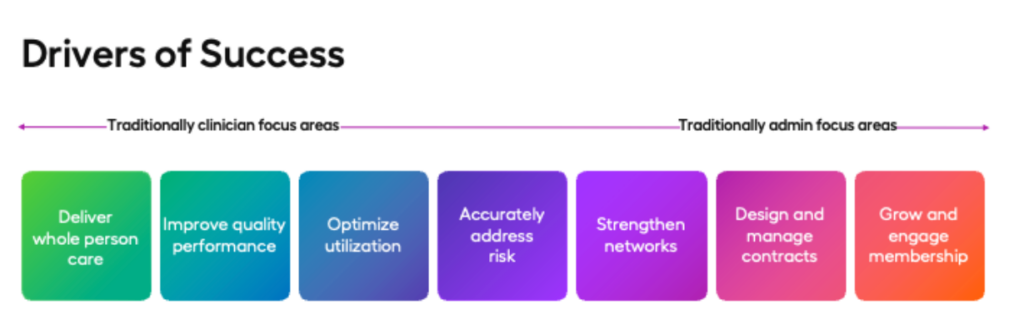
Take the ROI equation from 2 operators who live on the platform: a provider-side care delivery company scaling across 18 health systems, and a provider-sponsored health plan in Oregon that had a rough go-live and fixed it.
Guidehealth: 1 million patients, every quality-focused customer at 4 Stars or better
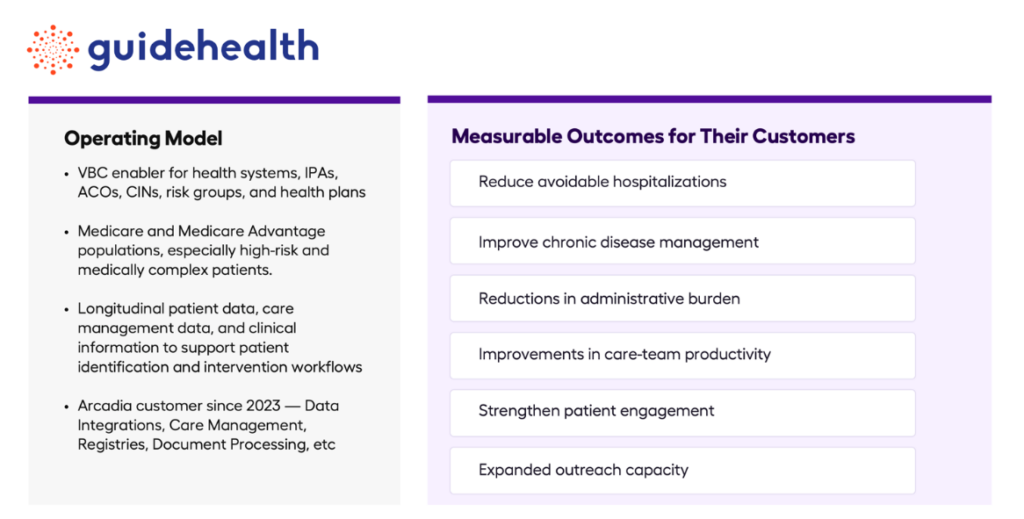
Dr. Sanjay Doddamani founded Guidehealth 3 years ago and was just named one of Modern Healthcare’s 50 Most Influential Clinical Executives for 2026. Guidehealth supports 1 million patients across 12 or 13 states for 22 enterprise customers, 18 of them health systems, and added 11 customers this year alone. That book runs the full spectrum: roughly 450,000 commercial lives, about 150,000 self-insured employer-sponsored, 50,000 to 70,000 Medicaid, some uninsured, around 200,000 Medicare Advantage, and close to 100,000 traditional Medicare across partners like Ochsner and Emory. Care gets delivered by health guides supervised by registered nurses, plus a conversational AI platform called RoseConnect™ for patient engagement.
Sanjay’s AI, data and intelligence framework splits the world into pretext and context. Context is what you build during the call with a patient. Pretext is everything the data should already have told you before the call: who to target, why, and what outcome you’re driving toward. “It’s shocking sometimes how blunt and dumb AI can be if you don’t enrich it with the right levels of pretext.” Without it, care management defaults to the old constraint of deploying a fixed number of care managers against the top 10% of high-cost, high-needs patients and hoping. His question is why healthcare should be the last industry to figure out how to support everybody with something.
Guidehealth was a beta partner on Ascent Care, and Sanjay’s original description of the process was “blood and gore.” He later upgraded that to “truly collaborative, but very demanding.” Guidehealth’s leaders deliberately stepped out of the way so their operators could collaborate with Arcadia’s product team directly, and the point was never customization for Guidehealth. It was making sure the product served patients everywhere. Minutes before our call he asked the nurse informaticist who led the beta whether she was happy. “Happy? This has been the game changer.” What changed is that the pretext now lives in the hands of the people doing the navigation: risk-stratified insights land in queues, care teams schedule and create appointments right out of the platform, and humans and bots both work off the same list, with bots handling the blood pressure checks. “Our work is enhanced because we have Arcadia capabilities. Otherwise, we couldn’t support 1 million patients.”
Now the scoreboard. Every Guidehealth customer where the focus is quality gaps has moved from 1 or 2 Stars to 4 or better, and many HEDIS measures now sit at 5. Sanjay pegs the return on that gap-closure work at roughly 3:1, which is mostly the money health systems leave on the table by running sick care instead of preventive care. On the heavier lift of care management, his floor is a 1.8:1 return, because in value-based care you do the work now and get paid a year later, and he isn’t waiting a year to find out it didn’t work. For the CFOs in the room, that’s the difference between care management as a cost center and care management as an investment with a payback period.
Then there’s the number I didn’t expect. Nursing is the single most expensive and most contested resource in care delivery, with 4 or 5 nurses for every doctor and the ERs, ORs and ICUs bidding for all of them. Community care management has to compete for that pool with the tools it hands people. After Ascent Care, Guidehealth’s internal NPS jumped 13.5 points to 84% favorability, with three-quarters of employees responding. “My NPS score is tied to our UX on Arcadia. If I have dissatisfied people, they will leave.” That’s a workforce retention line item, whatever the org chart calls it.
Where this gets interesting for a health system is the combined-customer effect. At Emory, roughly 450,000 patients sit in the book, about 150,000 of them Medicare or Medicare Advantage, and something like 25,000 of those need care management at any given time. Whether it’s Emory’s care manager or Guidehealth’s, whether the patient is employed-physician or independent, everyone logs into the same Arcadia platform and works the same list. “All boats rise” is how Sanjay put it, and the group text with Meucci is apparently called Guidecadia. His three-legged stool is Arcadia, Guidehealth and the customer: Arcadia is the data chassis, Guidehealth is the output layer that picks up the phone, and the health system brings the population. He chose that stool on purpose. “I’m not putting $100 million into R&D to build an Arcadia.” Guidehealth used to describe itself as a managed services organization with digital tools. “Today, I just say we’re a care delivery organization that has very advanced digital resources.”
One last thing from Sanjay, because it’s the part that matters. Patients who were lost to the system are getting found. One patient’s markers pointed to malignancy, got screened earlier than the system would have managed on its own, and was caught in time. “It’s not an odd occasional thing. It’s a very consistent thing now.”
Samaritan Health Plans: from 160 analyst hours a month to 24, after a rough start
Samaritan Health Plans is the provider-sponsored plan in Oregon: about 87,000 Medicaid members through IHN across 3 counties, roughly 1,500 dual eligibles it kept after exiting Medicare Advantage this year, and around 1,500 large-group commercial members, with a MultiCare-related expansion that Ben Myrstol expects to change the plan’s scale next year. Myrstol is the director of operational platforms and data, 21 years into a data career, and he came in as a consultant before he came in for good. His job is the foundation: Arcadia is where the clinical data meets the claims data, and it’s the single place the plan surfaces numbers to providers, aligns value-based contracts and keeps everyone looking at the same figures.
I’m including the messy part because it’s the most credible part. Samaritan contracted with Arcadia in 2019 and went live in 2020, and the go-live was rough. Hybrid HEDIS measures need clinical logic on both sides, and across 1,100 providers and 100,000 members at the time, Arcadia knew which questions to ask and Samaritan didn’t yet have the expertise to answer them. Myrstol’s assessment is even-handed: both sides messed up. When he arrived in 2022 he spent the first year rebuilding the relationship before he touched the data, and then he touched the data properly. One mass validation to earn confidence, then only year-over-year pattern checks unless a measure is new. Don’t over-engineer it. Get the right people in the room and don’t let things fester. Open tickets went from 200 to 30.
Here’s the cadence today. When the Oregon Health Authority releases its specs on January 1, Myrstol has his logic by month-end, is validating in February, and releases the full set on April 1, validated to a 95% accuracy target that usually lands at 98%. “We trust the data that is in Arcadia. The integrity is there, and we are confident these are our true numbers.” That sentence is the whole point of a data foundation. Everything else is a dividend.
And the dividends are specific. Monthly provider scorecards used to eat 120 to 160 hours a month of an analyst emailing spreadsheets, which is also a great way to burn through analysts. That job is now 16 to 24 hours, and most of it is for dental and behavioral health partners that aren’t on the platform. “Now the data analyst can be a data analyst and not a copy/paste bot.” OHA audit findings dropped from 15 to 20 a year, the kind of number that makes a governing body raise its eyebrows, to 2 to 4 minor ones, usually formatting, with hundreds of members affected instead of thousands. Providers see the fruit of their labor in the data without waiting a quarter, so the conversations moved from arguing about the numerator to asking whether no-shows are a transportation problem or a nutrition problem. Ascent Performance closes gaps that would otherwise sit on the list waiting on supplemental data. Cost and utilization dashboards show why a member went to the ED, who’s on a high-cost drug and who stayed 3 extra days, which feeds premium setting for next year, medical necessity audits and care coordination now. On the wish list: the conversational analytics in Ascent Insight, once he’s satisfied the clinical logic is sound.
If you run an integrated system with a provider-sponsored plan, this is the model. One platform, one dashboard, no arguments about who gets credit for a closed gap, no waiting 3 months on lagging claims to see how the network is performing. Close the gap, pay the bonus, watch the Star rating move, and put the energy you were spending on data matching into the total cost of care.
Across the rest of the roster
This pattern holds beyond my 2 interviews. A few from Arcadia’s own customer stories:
- Ochsner Health Network co-developed Ascent Finance. Julie Grantz, VP of value-based insights: “During the next year, we’ll be able to tell our network of providers that they can expect to earn X amount of dollars at the end of the year based on their current performance. We’ve never been able to do so in the past.”
- Rush Health unified data across 4 hospitals, 140 practices and 2,300+ employed and independent providers into one population health foundation and built a clinical integration program on it. Result: $19.8M in Medicare ACO cost savings, $9.6M in shared savings and a 97% quality score.
- WellSpan Health manages nearly 240,000 lives across 220 care locations with data that used to sit in more than a dozen EHR instances. Arcadia normalized 2,600 physicians’ worth of it, which is what let WellSpan step into two-sided and fully delegated risk with accurate stratification, gap closure and referral management.
- Integrated Health Partners, the FQHC-controlled network in Southern California, runs 9 health centers on 9 different EHRs across 97 sites and 389,000 lives, with nearly 20 connectors into Arcadia. Dr. Jay Lee, the medical director: “In one of our recent years, we closed 44,000 gaps, which is unheard of. I’d never been able to do that in my career.” IHP is the top performer for 3 of its contracted health plans, cut urgent-care-eligible ED visits by nearly 3% and 30-day readmissions by 7%, and moved high-cost infusions to the patient’s ZIP code, including home.
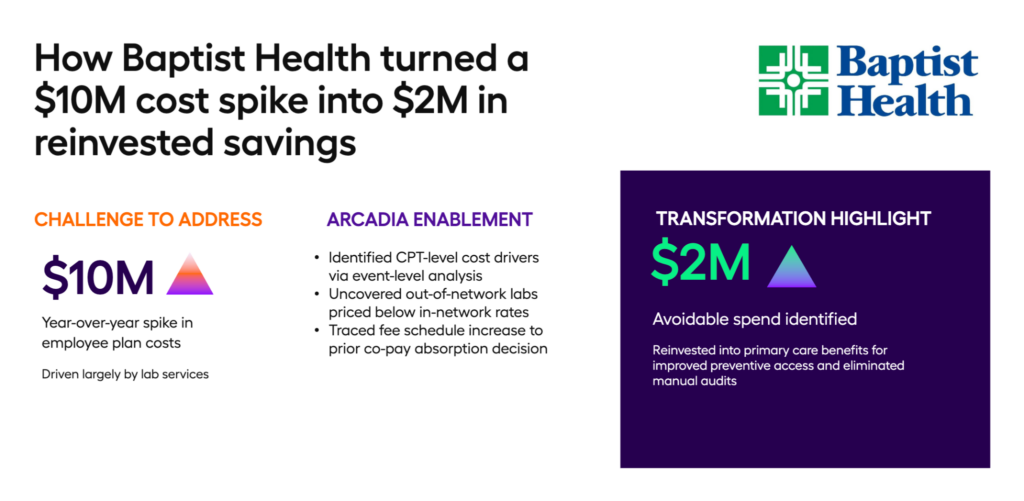
- A population health leader who’s worked at California DHCS, on conversational analytics: “Being able to ask that as a question as opposed to having to ask a data analyst to answer it is profound and transformational.” A Baptist Health leader said the same thing with less ceremony: curious C-suites can ask questions “without bothering my team.”
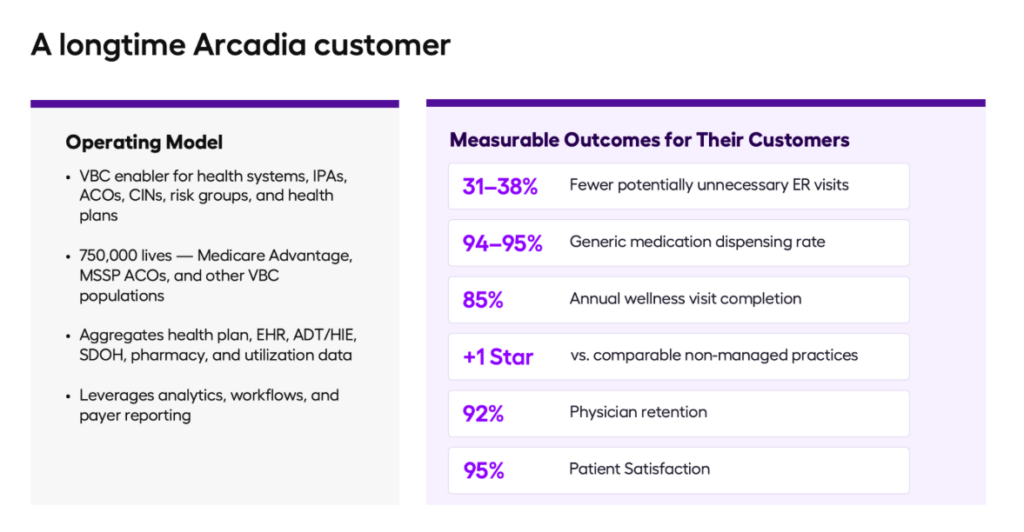
That’s 2 payers, 3 health systems, an FQHC network and a Medicaid agency describing the same mechanism. Trusted data first. Then the results compound.
Check the scoreboard.
Here are 3 questions for the people who will read this piece, mapped to the sections above:
- For the CEO: if the AI strategy slide in your board deck had to name the data it runs on, could it? Meucci’s line about megaphones is uncomfortable because it’s aimed at the strategy.
- For the CFO: how many analyst hours a month go into reconciling numbers with your payers or your providers, and what is a year-end surprise on a value-based contract actually costing you versus in-year course correction? Samaritan and Ochsner have both numbers. You should too.
- For the population health leader: what share of your panel gets any care management today, and what would it take to get past the top 10%? Guidehealth’s answer was pretext, a platform, and a beta program with some blood and gore in it.
Meucci put the stakes better than I can. “The next wave of AI value won’t come from better models. It will come from better execution.” That’s the CEO of a data company telling you the model isn’t the moat, and he’s right. Organizations doing the blocking and tackling now, the connectors, the validation, the single source of truth nobody argues with, are the ones whose AI initiatives will hold up in 2027 and the ones that will bend fastest when CMS changes the rules again. Everyone else gets a very expensive megaphone.
His other mandate for Arcadia was simpler: outcomes matter more than anything else. It’s a good mandate for your data strategy too. If your 2027 plan has AI on the top line and a fax machine somewhere underneath it, learn more about Arcadia Ascent or request a demo and make the Arcadia team show you what the foundation looks like when it’s done right.
Let’s get after it.