
Oura’s Overpay
diving into the marquee health tech deal of Q4 along with a one-pager on HCA
Happy Thursday, Hospitalogists,
Tomorrow I’ll be out in Tulsa playing Southern Hills, and today we have a quick recap of some recent news along with more hospital earnings stuff. I hope you enjoy and if you’re playing golf this weekend, hit me up with where the action is happening.
Let’s dive in!
Sponsored by Lumeris
Let’s talk AI and primary care to end the year in style.
1 in 5 patients switches providers in a year. Nearly 90% say the old one was hard to deal with.
That should tell you everything you need to know about the stretch between visits. AI might be primary care’s best shot at filling it.
So On Dec. 8 I’m sitting down with Dr. Jim Geracci and Doug Rogers of Tom by Lumeris to talk AI, patient connection and our 2027 predictions.
Oura buys Counsel Health for $625M including some updated financial info on OuraCopy anchor linkCopied
- It’s been an interesting year for Oura between squeezing out all of the growth it can muster pre-IPO to now buying an AI-enabled virtual primary care offering in Counsel Health for $625M in all-cash. From the release:
- Counsel combines medical AI with in-house physicians to deliver immediate, high-quality guidance and care. By pairing Oura’s continuous biometric data with Counsel’s platform and on-demand human doctors, Oura Members receive care across a spectrum of needs. Members can start from an Oura insight or immediately chat with Counsel’s medical AI to get personalized medical advice. When needed, the conversation can escalate to a board-certified Counsel physician within minutes, all within the Oura App. The acquisition accelerates the delivery of Oura’s vision of more proactive, personalized healthcare while advancing Counsel’s vision of expanding access to care through responsibly designed medical AI.
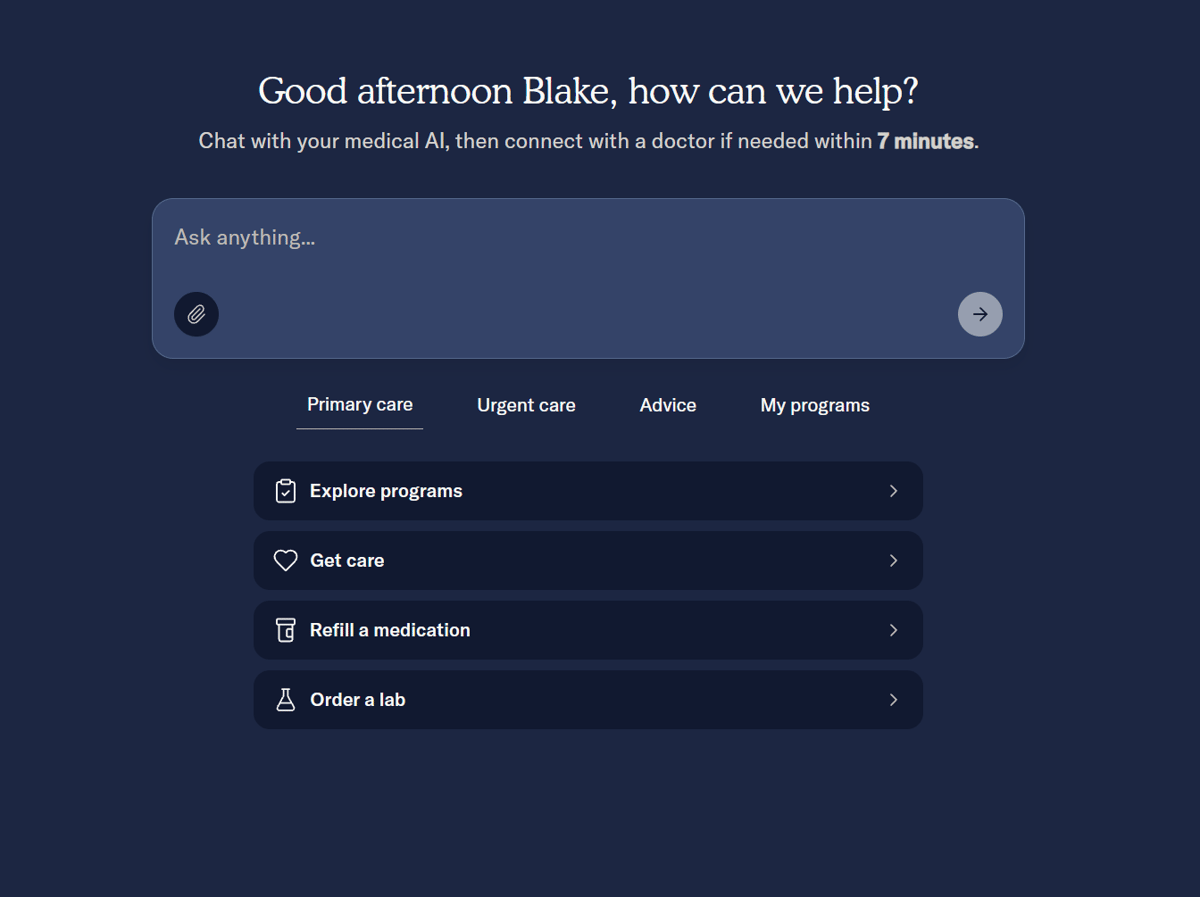
- Counsel Health was / is an interesting company making notable moves, including a previously announced partnership with Oura, joining ACCESS and launching GLP-1s. $625M is a LOT of money that allows Oura the economic upside of owning Counsel and its growth trajectory - vertically integrated with Oura - which I suppose outweighs the partnership option. They liked what they saw, clearly. But I really want to know the deal structure because…why buy at that price tag? I question the capital allocation, but if you can scale Counsel’s AI PCP model across Oura’s 6M user base, there are economics to unlock faster by buying versus building
- Counsel had also most recently raised a $25M Series A basically one year ago (with a $11M Seed back in October 2024 led by a16z). So you go from raising $11M to raising $25M (led by a16z and Google Ventures) to being sold for $625M in like 26 months. What the actual hell. I’m legitimately jealous.
- What an excellent, superb outcome for the Counsel Health team. I mean surely there are some pretty hefty earnout provisions attached to this number but to go from Series A to over half a billy is indicative of how insane the appetite is for promising solutions in this arena.
- Hospitalogy is now pivoting into AI-enabled async primary care I suppose. I mean come on guys. What are we doing?
- Counsel combines medical AI with in-house physicians to deliver immediate, high-quality guidance and care. By pairing Oura’s continuous biometric data with Counsel’s platform and on-demand human doctors, Oura Members receive care across a spectrum of needs. Members can start from an Oura insight or immediately chat with Counsel’s medical AI to get personalized medical advice. When needed, the conversation can escalate to a board-certified Counsel physician within minutes, all within the Oura App. The acquisition accelerates the delivery of Oura’s vision of more proactive, personalized healthcare while advancing Counsel’s vision of expanding access to care through responsibly designed medical AI.
- We also received some updated financials from Oura, including ‘record’ Q4 growth to $533M, 153% YoY growth and 87M in adjusted EBITDA (16.3% margin). Altogether in fiscal 26, Oura generated $1.75B (92% YoY growth) so growth accelerated quite a bit in Q4
- The bigger picture here - at least, the most interesting part to me - is whether these longevity and wellness-centric players like Whoop, Oura can ultimately penetrate the new markets they’re targeting (employers, payors). Wearable users are among the most engaged users when it comes to health products (Oura even has some pretty great engagement with seniors). So attaching this daily tracking of heart rate, sleep, and other metrics like HRV, V02 Max, and whatever else the next longevity bro comes up with to referrals to primary or mental health or downstream lab/imaging/visits creates a pretty nice flywheel on the cash pay, consumer front. Now the question is…can players like Whoop, Oura, and Apple (watch) translate this ongoing, daily collection of health data into a connected ecosystem like we’re seeing with Oura + Counsel, or Whoop and Whoop’s medical group and participation in programs like ACCESS. The consumer is nice, but the honeypot is the employer or payor. We are at the forefront of these attempted efforts and as a Whoop user and someone dabbling in areas like ChatGPT for health and Ownyourlabs, I’m here for it. If you can get a somewhat equivalent level of primary care by attaching your wearable to messaging based, async and virtual primary care, assisted by AI, and getting labs a-la-carte more conveniently and more personalized to you…who says no?
- One of the harsher criticisms I’ve seen on the wearables front is (1) they are not FDA approved medical devices and therefore (2) many of their stated metrics determining your day to day health are self-defined. For instance - the sleep tracker might have been on the fritz one morning and gave you a dismal recovery score. Or maybe you drank 4 pints of wine and your recovery is 100%. Does that determine your mood and energy levels for the day? Maybe, but now, given these players have entered ACCESS and are moving into lab testing and other traditional medicine functions…maybe this ‘proprietary’ datapoint now prompts an unnecessary follow-up visit or in Oura’s case, tells you to ping a Counsel Health provider. To be clear, this is the bear case - more or less, that wearables data is both inaccurate, inconsistent, and equates to voodoo for a worried well or longevity bro population only, and doesn’t solve bigger issues in healthcare. I say let the consumer decide. What say you?
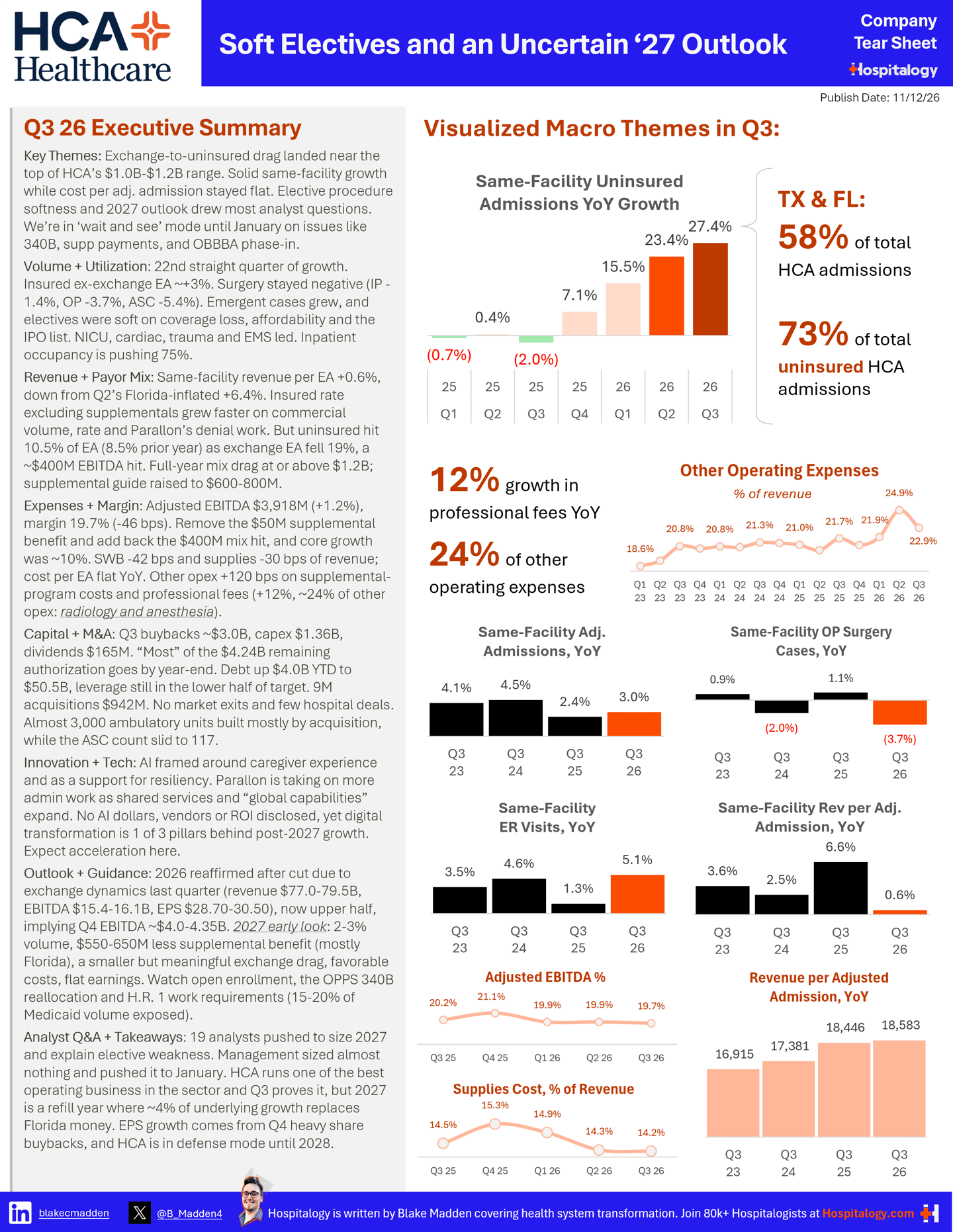
HCA Q3 26 Earnings One-PagerCopy anchor linkCopied
Hospitalogy in OctoberCopy anchor linkCopied
Here’s the roundup of my articles from the newsletter and pod in October!
You can view the entire Hospitalogy archive here.
PS - PLEASE subscribe to Claims Denied on Apple Podcasts and leave a review if you feel so inclined! It helps a ton with my livelihood and rankings.
NewslettersCopy anchor linkCopied
- Healthcare needs an SEC
- Wash the laundry
- AI is a megaphone for bad data
- The RHTP $4B report card
- CEOs: AI is your job, not your CIO’s
- The $108B AI opportunity for specialty practices
- VBC, AI, and a dream
- A Kiwi pharmacist walks into US healthcare
- Hospital M&A is back!
- The 4 emerging health system archetypes
Podcast EpisodesCopy anchor linkCopied
Some absolute bangers this month:
- Members Leave Carriers, Not Brokers (with Will Johnson, Co-founder and CEO of Gyde)
- Standard as Possible, Different as Necessary: Inside Jefferson Health’s Payvider Bet and LVHN Integration (with Dr. Baligh Yehia, President of Jefferson Health)
- Inpatient AI, Payor Win-Wins, and Token Costs (with Dr. Shiv Rao, co-founder and CEO of Abridge)
MISCELLANEOUS MADDENINGS
Next week I’ll be on site at HLTH. Ping me if you’re around - would love to catch up! I’ll give you guys an update on the Southern Hills round next Thurs. Enjoy the weekend, fam.
Thanks for the read! Let me know what you thought by replying back to this email.
— Blake