
A flux capacitor for the hospital
Capacity Health on boarding, ECAT and decision latency.
In partnership with
Hello Hospitalogists,
Voluntary ECAT reporting starts in under 2 months. Your boarding, walkouts, door-to-room times, and length of stay are about to become a public number, and a few years later, a payment number.
That’s the backdrop for today’s deep dive on Capacity Health, an AI-native platform built for the ED.
Get ready for the best argument I’ve heard for why hospital capacity gets made or lost one patient decision at a time.
Capacity Health: A Flux Capacitor for the HospitalCopy anchor linkCopied
Picture a patient a few weeks into a new cancer treatment who comes into the ED lightheaded and vomiting. Absolutely miserable. Everybody reads it the same way, and reasonably so: treatment-related nausea and dehydration. Fluids, anti-nausea meds, home.
But the clues to the true diagnosis are already in the data, just inaccessibly. A new therapy is on their med list from a different hospital, and the patient doesn’t know the name. Their labs post one by one – mostly normal, at first glance. Their physiologic monitoring doesn’t respond to the fluids quite the way it should. Each piece looks unassuming on its own, and nobody has time to line them up mid-shift.
Now picture software that has been assembling the clinical picture since the patient walked in. It lines those pieces up and notices they don't fit simple dehydration. So it puts this in front of the physician: this pattern is consistent with a rare life-threatening complication of the patient’s immunotherapy.
The physician reads the reasoning and decides whether to work it up. Some of those complications can turn serious quickly, so catching the pattern early can matter. And it only shows up because an intelligent clinical AI has been putting the picture together the whole time, not just taking one snapshot on arrival.
David Kim, MD PhD and William Dixon, MD MSEd, both emergency physicians and the co-founders of Capacity Health, understand scenarios like this firsthand. Dixon told me in frank terms that even the best doctor in the world could be standing at that bedside for this patient’s entire stay and miss the true diagnosis. (By the way, these are two of the most impressive people I’ve had the pleasure of meeting.)
That’s where Capacity Health fits in. It’s building a platform designed to help care teams and operations teams make decisions from the same underlying patient information, review evidence-supported care options, and understand the resources those options may require. The vision: a “flux capacitor” for the ED, if you will...In Back to the Future, the flux capacitor let Doc Brown jump to the moment that mattered the most. Capacity Health is going after a version of that: moving the decisions that hold up an ED earlier in the visit, so the clinical team isn't stuck waiting for the clinical picture to come together. In a department where time is the scarcest resource there is, that's the closest thing to time travel I've seen.
Great Scott, there’s capacity in hereCopy anchor linkCopied
The idea for Capacity Health grew out of what Kim's NIH-funded AI lab at Stanford kept finding: hospitals collect far more useful information than they ever put to work. Kim and Dixon founded the company to build toward what they call (with a straight face and a slight wince, but to be honest, the best description) "hospital superintelligence," a long-term vision of a hospital that understands every patient at once, and what it will take to care for each of them. The idea under the branding is pretty simple: Hospitals can lose capacity to complex and delayed decisions, not just to “not enough” beds. And sometimes the full beds aren’t even full appropriately (any exec will tell you that dealing with the 2 Midnight Rule and observation downcodes). The information a doctor needs to make those decisions faster is mostly available – already in the building, in the lab feed, in a discharge summary from the hospital across town. Putting it together in time to make an informed decision can be difficult, especially as each patient’s history and chart grows increasingly complicated. Capacity Health calls that gap "decision latency," and the company’s goal is to help close it with enabling technology.
Dixon brings the company-building side. He's an ED doc who co-founded Signos, the GV-backed digital health company, before this. He and Kim met in residency, and Capacity Health licenses the technology developed in Kim's lab from Stanford. Dixon also told me he's been reading Hospitalogy for 4.5 years, which I'm choosing to believe had zero influence on how much I like this company. Zero! This is a thoughtful, data-driven team building something I think is extremely promising.
Here's the TL;DR for anybody reading between meetings:
- Capacity Health’s starting point is a persistent, continually updated model of every patient. It organizes information from the EHR, physiologic monitoring, and outside records as the record changes, and presents relevant findings and care options for clinician review.
- That model is designed to inform clinical and resource decision support at the bedside, in the hospital's queues (CT, beds, nurses) and across a multi-hospital system. Stated otherwise, the goal is to help unlock effective CAPACITY…ha…get it? (I still can’t believe the name Capacity Health hasn’t been taken all of this time)
- Potential value levers include:
- Predicting and mitigating ED boarding
- Better-informed triage capabilities (e.g., patients with likely actionable CT findings get prioritized in the scanner queue)
- Improving throughput (AKA, length of stay)
- Bed status optimization (admissions vs. observation stays)
- Headway on CMS’s new ECAT mandate, which puts ED and hospital throughput in the spotlight in a major way.
Free information, left on the floorCopy anchor linkCopied
One of the best aspects of AI I hear constantly is…”AI never gets tired. Agents never waver in their tone of voice or get mad on the phone or online. They can work at all hours of the day.” With this framing, I can’t imagine a better setting for AI (when done correctly mind you) than within the ED, because in status quo ED care today, most of the data never gets a second look (and some never gets a first look). There's a lot coming in, and it's fragmented across systems: the EHR, the lab feed, the bedside monitor, hospital protocols, the notes, the records from the hospital across town. Physicians and nurses are freakin’ busy, guys. That's not a failing. It's just more information, and more work, than one person can keep up to date on their own, let alone for fifteen patients.
Current ED protocol goes something like this: Hook somebody up to a bedside monitor in an ED and it streams heart rate, blood pressure, O2 sat and respirations, plus ECG and pulse waveforms. Every second. Then a nurse charts a handful of vitals every few hours, which is what the doctor reviews, while the detailed data underneath just...evaporates.
Nathaniel Miller, MD, an emergency physician and VP of clinical innovation at Vanderbilt University Medical Center who's advised Dixon since Capacity Health's early days, told me that already available patient data gets underused "99.999% of the time."
But Capacity Health recognizes this data as hard to get but valuable information that we leave on the floor. Free information, just sitting on the floor. In this reimbursement and technological environment!
For 6+ years, Kim’s lab has been chasing a pretty obvious question: what happens if you…actually use the stuff? To be clear, the published work below is part of the research foundation that helped inform Capacity Health’s approach, and not product results (the founders were careful to keep those separate), but a few papers do a ton of great explaining on how much opportunity exists here:
- 15 minutes of monitor data may flag who's about to deteriorate. The lab took about 20,000 ED visits where triage vitals looked totally normal, pulled 15 minutes of ECG and pulse waveforms, and predicted who'd go tachycardic, hypotensive or hypoxic over the next 90 minutes. The researchers reported better predictive performance than triage data alone. (npj Digital Medicine, 2023)
- Monitors can catch AFib the ECG misses. Across 65,000+ monitored ED adults, 3% showed atrial fibrillation on continuous ECG and went home with no AF diagnosis and no blood thinner. Most of them were anticoagulation candidates, their stroke risk ran about triple, and only 19% got diagnosed within 2 years. The misses skewed toward Medicaid patients, people without a PCP, and Black and Hispanic patients which is a health equity convo for another day. (Annals of Emergency Medicine, 2025)
- A smarter CT queue may beat buying another scanner. In a single-center simulation of 20,795 ED CT studies drawn from about 314,000 ED visits, the team predicted at order time whether a CT would come back actionable, then simulated re-sorting the queue. The 90th-percentile wait for actionable findings dropped by about 43 minutes, and the share of actionable results back within an hour went from roughly 48% to 57%. Non-actionable scans waited about 14 minutes longer. They reported that tradeoff instead of burying it, which I respect. (Radiology: Artificial Intelligence, 2026)
All from a machine whose main job, as far as most of us peons who don’t run AI labs can tell, is beeping annoyingly.
So why start in the ED? The ED is the primary source of admissions and manages an incredible amount of patient volume. Somewhere between 50% and 70% of admissions come through the ED, which makes it the biggest and least predictable input to the inpatient census. When something goes sideways down there, there are ripple effects across the hospital. Hallway beds, doubled up rooms, delayed transfers – even elective surgeries can be among the first things to go when the ED backs up. That's real money falling off the OR schedule in addition to inefficient and expensive patient care associated with ED boarding. Double whammy.
Kim's version is more clinical. Most of medicine, he says, is a slower and more homogeneous subset of emergency medicine (a concept I find personally fascinating), but the reverse isn't true. Build something that survives a Friday night in the ED and the bet is it'll work anywhere in the building. Build it for a scheduled clinic visit and it gets eaten alive by about 10pm.
Breaking down the Capacity Health modelCopy anchor linkCopied
Most health systems run some version of a command center these days. Beds, boarders, walkouts, door-to-doc, a big wall of screens. The catch is those tools describe capacity from the top down, usually after the backup has already formed.
Dixon described what that looks like from the ED: a notice comes down from the operations center saying the hospital is at capacity level 4, so please go ahead and discharge people.
"Super helpful, thank you." He manages a wry grin.
So he…keeps doing exactly what he was already doing, because the notice can't tell him which of his patients can actually go home – and getting your patients the right care is always the priority.
Capacity Health's bet is that you can't forecast a hospital until you understand the patients inside it at the most granular level. Dixon calls clinical intelligence and operational intelligence "two sides of the same coin."
Kim walked me through what makes Capacity Health different, and the first piece is continuity. A new care question doesn't start from scratch. It builds on a persistent model of each patient, carrying relevant information forward as labs come back and shifts change hands. As new information becomes available, the system updates considerations for a clinician to review alongside the underlying findings and supporting information.
The second piece is outcomes, and you didn't think you'd make it through a Hospitalogy piece this fall without a college football reference, did you? Capacity Health sends every call to the replay booth (though this one overturns things AFTER the game, AKA the encounter). It only predicts outcomes it can actually observe, and then it checks. Predictions are evaluated against observed outcomes, and those analyses inform continuous model improvement. Someone more technical would call this ‘recursive learning’ (as the dad of a 3 year old, I call it ‘don’t do that again’).
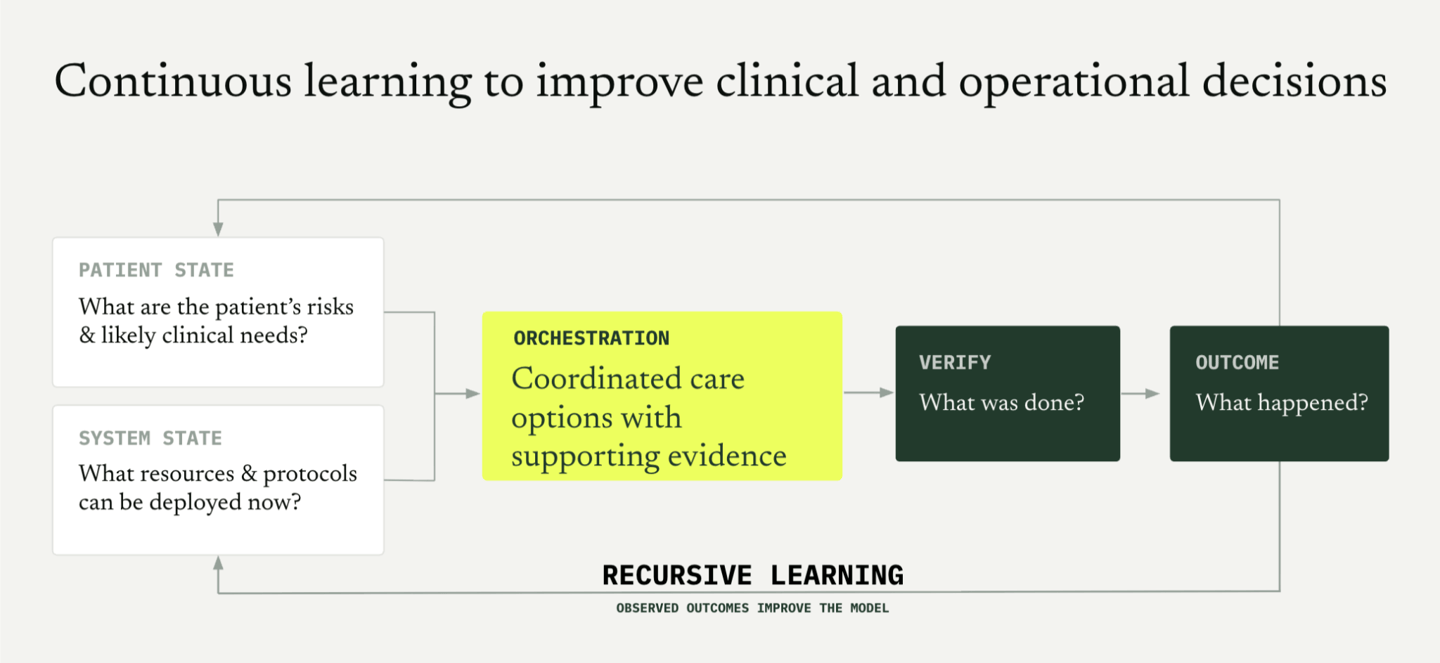
For example, did the clinician act on the recommendation, or did the patient we sent home turn up at somebody else's ED within a given timeframe?
Most medical AI never goes to the booth. It gets graded on benchmarks instead, like which model answers more board questions or which one doctors like better. A group of researchers from Stanford, Harvard, ARPA-H and the big AI labs argued in Nature Medicine this summer that those benchmarks are "misleading and insufficient" and that medical AI needs task-based testing. Did the thing happen, and did it help? That's exactly how Capacity Health keeps score.
The third piece is coordination. Care in an ED depends on coordinating shared resources, from CTs and MRIs to a nurse's attention and a pharmacist's med review. Capacity Health models the patients and those shared resources together, and a recommendation for one patient is designed to account for how it affects everybody else. An individual hospital can have hundreds of policies governing things like who can be transferred and who needs an isolation bed. Capacity Health maps all of them. Every single one.
This, right here, is the future of ED care. And I’m here for it:
On a shift, the app reads like a to-do list with a brain. A focus view on the phone organizes every patient's possible next steps for the physician to consider (this patient is a great transfer candidate, this patient should be seen by palliative care), each one tied to a possible differential diagnosis with the evidence underneath so the physician can quickly review the reasoning, and a named person who owns it.
Both founders have walked into exam rooms already caught up on the patient’s history and most recent clinical picture. Patients have told them they know them better than their own specialists do.
Up a level, at the hospital, the same models inform operational queues. Picture 40 patients waiting on CT on a busy night. A handful have findings where a 1 hour wait versus a 6 hour one can change the outcome. A bunch more are stable and waiting on the one scan between them and the parking lot, sometimes for 8 hours. While individual clinicians already triage that queue as their patients change, Capacity Health can help the whole department do it with more information. Think of a good starter on a Saturday morning who sends the right group off first and lets the twosome play through. Do that, Kim says, and you could turn that bed over multiple times, a win for patients and the hospital.
Up another level, the system. Once clinicians determine a patient at the hub has been ruled out for surgery, a cath or a stroke intervention, for example, admitting them to an associated community hospital could save money and free up hub beds for the transfers that need them next. Most multi-hospital systems say they want this. Few can see their patients well enough to pull it off in real time.
I've written a fair amount about systems of record versus systems of action, and this is the cleanest acute-care example of a system of action I've come across in a well defined domain that hospitals can deploy. The operational forecast comes straight out of the clinical model, and the founder’s research points in a promising direction.
Capacity Health is building a category-defining, AI-native platform.
CMS built a scoreboard, your ED's about to be on it, so… get on itCopy anchor linkCopied
Boarding stopped being a winter problem a while ago. Now Washington has put a number on it.
CMS finalized the Emergency Care Access & Timeliness (ECAT) measure in the CY 2026 OPPS final rule. It counts the share of your ED visits that hit any of 4 measured outcomes:
- more than an hour from arrival to a treatment room
- the patient leaves without being seen
- boarding more than 4 hours after the decision to admit
- a total ED stay over 8 hours
Voluntary reporting starts in CY 2027, which is about 2 months from now. Mandatory reporting follows in CY 2028, tied to the CY 2030 payment determination, and hospitals that don't meet the requirements can lose up to 2 percentage points off their Medicare outpatient payment update. ACEP, which does not typically throw CMS a parade, threw CMS a parade. “You cannot fix what you refuse to measure,” said L. Anthony Cirillo, MD, the college's president at the time.
Think of it as the CFP committee rankings for your ED, except this time the rankings come with REAL money attached and you can't blame SEC bias. CFOs, this is the date to circle.
Meanwhile demand keeps climbing. Sg2 projects adult inpatient discharges up 10% through 2035 and 176 million inpatient days a year by then, against a bed base that's already more than 75% occupied and heading toward 85%. More patients, roughly the same beds.
Love that for us.
The part your command center can't see showed up in JAMA recently. Alex Janke and colleagues pulled data from 56 EDs across 17 health systems, covering nearly 492,000 general medicine admissions. 53.6% boarded at least 4 hours waiting on a bed. Separately, more than 17% (roughly 85,000 people) went at least 4 hours after the decision to admit with no inpatient team managing their care.
At all.
About 4,500 waited a full day, and 3 hospitals accounted for 61% of them. Janke's read was that it comes down to "how a hospital organizes the work." Waiting on a bed and waiting on a decision-maker are 2 different problems, and only one of them is on your dashboard.
Healthcare AI's first wave mostly went around that problem. It went where the workflow was predictable (a scheduled clinic visit with one doctor and one note) and ambient documentation fit right in. It's why most health system CIOs can name their scribe vendor in about 2 seconds.
But the ED is a harder problem. The Stanford emergency medicine department measured ambient scribe use in its own ED. Across about 10,000 encounters and 100 attendings over 13 months, ambient scribe use was associated with 72.6 fewer seconds of documentation per encounter. Call it 24 minutes over an 8-hour shift if you used it on all 20 patients. 72 seconds!
But the benefit was biggest in telemedicine and smallest in triage and the lobby, so it helped least exactly where the ED is most chaotic. STAT's Brittany Trang made the point in her September piece: ambient scribes are the most advanced AI in the ER right now, and they still haven't "changed the status quo." Her story opens at Brigham and Women's on an early-September evening, with 152 patients in the ED counting the waiting room and 61 acute care rooms to put them in.
152 patients. 61 rooms.
Faster notes don't move those people upstairs. Meanwhile a scoping review in Academic Emergency Medicine found 94.5% of 605 studies on AI decision support in the ED were still stuck in the earliest preclinical phase. So the tools that got deployed write notes, and the promising ones mostly never got deployed...which leaves a pretty big opening for a company focused entirely on earlier action and measured outcomes, for the patient and the hospital...
Where Capacity Health thinks the ROI could beCopy anchor linkCopied
Capacity management is the game for the next 5 years. Reimbursement from CMS and commercial payers is only going one direction. The for-profit operators already run census, length of stay and labor on a very short leash. In Miller’s view, 2 KPIs decide who comes out ahead: nursing productivity and utilization management.
Capacity Health is keeping an eye on preliminary data, consistent with high diagnostic accuracy, earlier identification of necessary workup, and potential effects on boarding, effective capacity and revenue. Peer review and patient-centered outcome trials are still ahead, but here are the types of win-win-wins the company is aiming for:
- For patients: timely care in the right setting.
- For clinicians: less time hunting for data and understanding the chart, and higher impact patient care.
- For health systems: one shared picture across clinical and operations teams, and more usable capacity from the staff, beds and data they already have.
Kim’s math on why this time matters is simple. If the median ED visit gets done in half the time, that's the same potential as having twice the ED beds and doctors, and nobody had to pour a foundation. How much this is worth depends on the hospital. I spent my pre-Hospitalogy career in healthcare valuation at VMG Health, and if you put a new ED tower next to faster decisions in the ED you already have, I know which one underwrites faster. In finance land, the best capital project is the one you never have to build.
Observation status is a significant economic variable; treat it like oneCopy anchor linkCopied
Picking the correct admission status is another significant economic variable. CMS and commercial payers have spent years pushing volume into observation status, which saves them money and costs hospitals the DRG. Layer the 2-midnight rule on top and you get an arms race nobody involved signed up for, with patients stuck in the middle – and one that many ED docs don’t even know they are in. Capacity Health’s argument is that surfacing earlier which patients may be at higher risk of getting worse, with the evidence attached, can help turn uncertainty into a status decision that’s easier to defend.
Something Miller pointed out that I appreciated: Calling an admission "unnecessary" does an injustice to the doctor and the patient, because figuring out who gets worse is the entire point of observation. Not every treatment works. If somebody improves, they're a responder. Better and earlier predictions about length of stay support a better-informed decision - and a tool like Capacity Health is designed to remove the guesswork about who a “responder” will be.
High-risk boarders can be surfaced for clinician review earlier. Stable ones can go to expedited discharge teams. Would-be walkouts can be flagged before they leave. Every 30 or 60 minutes you shave off a stay compounds fast when you're seeing hundreds of patients a day.
Line all of that up against ECAT's 4 measures and it maps almost perfectly. If you're building the throughput program you're going to get publicly graded on in 2028, put Capacity Health on the evaluation list. Full stop.
Beyond the ED: More beds? Where we’re going, we may not need more bedsCopy anchor linkCopied
Every service line in the hospital touches the ED eventually, and the founders see the same patient model being immediately useful beyond it. "There’s not a decision made in the hospital that does not benefit from better patient understanding," Dixon told me.
It’s not hard to picture how that could work someday. Imagine a palliative care team that spends hours pre-charting before every consult with the ED. If the patient’s picture is already assembled, that prep can shrink considerably. The same goes for hospitalists, case managers and utilization reviewers. All of them spend their days rebuilding the same patient out of the same historically fragmented information. Whoever owns the patient model could serve every one of them.
Further out, the founders talk about what the possibility of "governed autonomy" could look like, meaning the system handles tasks that sit on a predefined pathway with a predictable ending. For now, though, everything clinician-facing is decision support with the underlying evidence surfaced, and the clinician keeps diagnosis, treatment and disposition.
Miller sees a bigger market than throughput. "You can't replace 10 years of training," he told me, and it's really hard to get experienced clinicians to move somewhere without serious infrastructure behind them. Decision support that could make a health system’s own protocols easier to access and apply in day-to-day care, whether a clinician is early in their career, new to the organization, covering a different hospital, or has worked in the system for years is, in his words, "a true attempt to increase the standard of care." The idea is to bring the relevant guidance into the context of the patient and the resources available at that site. That broadens the opportunity beyond patient flow to helping clinicians put shared standards into practice across every hospital in the system
A final noteCopy anchor linkCopied
Capacity Health built an illustrative simulation called Turbo Shift that plays the same ED day twice, with identical patients, arrival times and number of beds. On the left, the day runs the way it actually did. On the right, Capacity Health flags what each patient may need as their picture changes, decisions move earlier, and you can watch the boarding curves pull apart. It's a unique thing to say about clinical software, and I mean that as a compliment- the simulation itself is built like an arcade game. Operators will recognize their own department on the left. Executives will go straight to the real numbers underneath. Getting both of those people to look at the same screen is clever as hell. When they showed me the Turbo Shift demo, I started cracking up. I love stuff like this. Why don’t more teams do fun, interactive things like this to drive home a point?
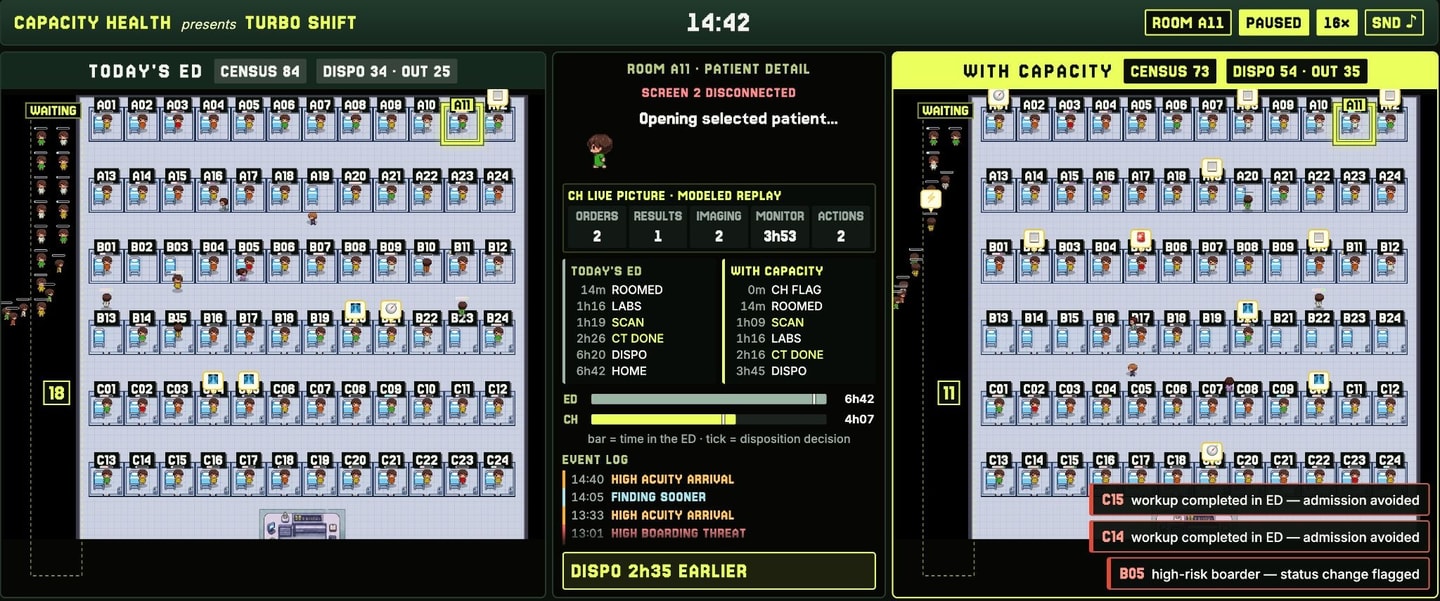
Example Turbo Shift SimulationCopy anchor linkCopied
We've spent about 3 years buying AI that helps us write about patients faster in ambulatory environments. And I get why we started there. But hospital capacity gets made or lost in the ED and on the floors, one patient decision at a time, and until pretty recently few companies were building from the patient up.
Voluntary ECAT reporting opens in about 2 months. After that your boarding, your walkouts, your door-to-room times and your length of stay become a public number. A couple years later they become a payment number.
If you own throughput at a health system, request a demo from the Capacity Health team. In a short working session, they’ll explore with you where decision latency may be creating avoidable delay and where greater visibility could reveal meaningful capacity.
This essay is a sponsored post in partnership with Capacity Health. I write these posts for companies with products or missions I believe can provide value-adds for Hospitalogy subscribers, many of whom work with/for ACOs, FQHCs, integrated health systems, health plans, and other risk-bearing organizations that want to learn more about potential value-based care partners.
If you’re interested in a sponsored deep dive, please reach out to blake@workweek.com!
Thanks for the read! Let me know what you thought by replying back to this email.
— Blake