
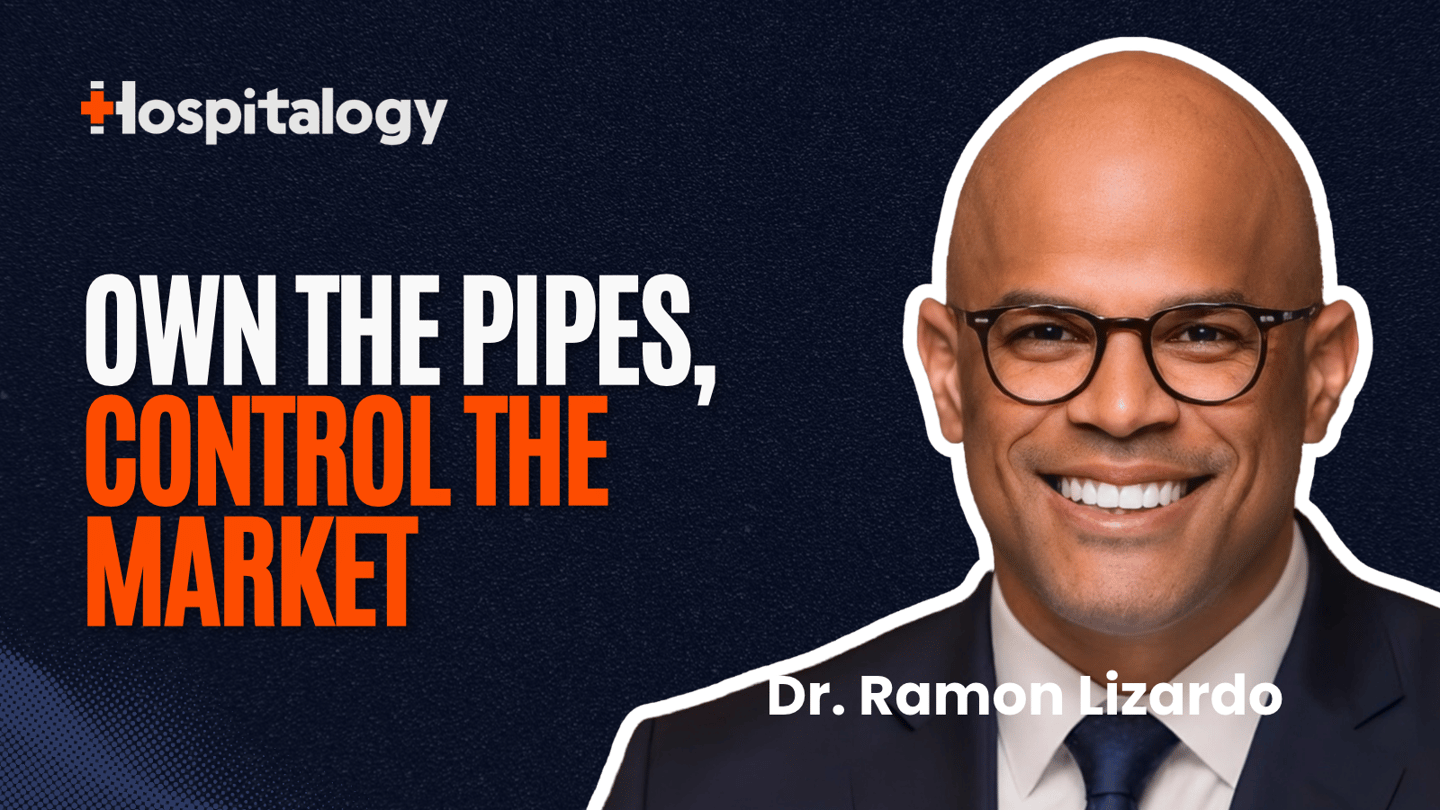
He made up the rate card and payers signed
Ramon Lizardo on owning the pipes into 911
Hospitalogists,
On a recent episode of Claims Denied, Ramon Lizardo shared how three questions scribbled on a Bojangles napkin eventually became Tele911. The company made Baltimore, Fort Worth and San Francisco cities where calling 911 can put a physician on your screen in under 37 seconds. When the Key Bridge collapsed, Baltimore called him at 3 a.m. and asked him to go live early.
We also discussed the physician hierarchy, why nobody teaches doctors how money works, and digital health’s profitability problem. Enjoy the read or listen to the full episode here.
Ramon Lizardo on owning the pipes into 911Copy anchor linkCopied
TL;DRCopy anchor linkCopied
- Ramon Lizardo didn't build a telehealth product so much as lock up the entry point to one: 911 dispatch. Counties got the service free in exchange for volume commitments, and payers supplied the revenue. Cost of goods, $92. Commercial rate, $967.
- By his own account, he made up those rate card numbers, printed them, and payers signed. His reasoning: the alternative was a $3,000 visit.
- He's now Chief Health Officer at Somethings, a peer-mentorship mental health company, chasing the rarest thing in digital health: profitability.
Every so often a guest walks through the mechanics of a business so plainly that you realize how much of digital health has been solving the wrong problem. Ramon Lizardo, MD did that about 35 minutes into our Claims Denied conversation, and I've been chewing on it since.
Quick background, because the arc matters. Ramon is the son of two janitors who worked in the school system and got him enrolled as a non-matriculated student at Rutgers while he was still in high school. College in the morning in his high school uniform, high school in the afternoon, then a sport, then a job. Undergrad done at 20. He didn't think he was smart enough for medical school, though he was already taking biochemistry and physics, so he never applied. Then he asked a classmate who had applied to 13 programs if he could look at one application. He kept it, and a month or so later, after she stopped showing up to class, he filled it out. That application got him in. When he ran into her later, she told him she hadn't gotten into any school.
He started medical school the day after finishing undergrad and had his MD at 24: 135 pounds, curly hair, working a Level 1 trauma center and fielding the immortal patient line, "can I get a second opinion?" His answer: "I haven't given you my first."
The financial education nobody getsCopy anchor linkCopied
Ramon's read on physician money habits is the sharpest I've heard, mostly because he located the scar tissue instead of the symptom. Residents watch their college friends marry, have kids and move up while they earn $43K, he said. Then one day the deposit is $16K biweekly, and the instinct is to catch up: the house, the Porsche. These doctors, in his words, "end up making a lot of mistakes."
He never took a finance class or a debt-management class in medical school. Healthcare is a business, he noted, and most doctors aren't trained to live in it. He doesn't think that's an accident: "if you teach enough people about the business, they're gonna figure out a way." Either they change the laws, complain about it, or leave the network and build their own thing.
That lands hard against everything we cover on price transparency. Transparency and financial literacy are the same fight from two directions. Once clinicians can read the P&L, they can see who is collecting rent and who is adding value, and the parties collecting the rent have little incentive to hand out the decoder ring.
What's filling the gap, per Ramon, is the creator economy. He's seeing medical students and recent grads build audiences on YouTube, land sponsorships and pay down school debt before they graduate, and he stressed it's not just one or two of them. Psychiatrists are posting mental health explainers; anesthesiologists are building pain-management channels.
Meanwhile McKinsey, Deloitte and Bain are going to medical schools with a simple pitch: you don't have to do a residency. Ramon took the Deloitte route and was making $327K a year about a year after leaving clinical practice, a slight bump over clinical pay, with no liability, no brutal shifts, an office with a view of the park, rent covered and an MBA paid for. Optionality has arrived for physicians, and health systems still budget as if it hasn't.
The hierarchy nobody namesCopy anchor linkCopied
I asked about the pecking order between specialists and primary care. Ramon didn't hedge. Of course it exists, he said, and it isn't confined to primary care; he pointed to emergency medicine and anesthesiology squaring off in the trauma room. What was new to me was where he traces it. As he tells it, USMLE Step 1, taken in the second year of medical school, effectively sorts doctors: one shot at a high score opens any specialty, while a poor one lands you in primary care. He said he's heard Step 1 is now pass/fail, which would flatten the sorting for newer cohorts. A cultural hierarchy with an examination-shaped origin story.
Here's the collision I keep coming back to. The clinical case for investing in primary care is strong, and I raised the recent physician fee schedule, which shifts reimbursement out of procedural specialties like orthopedics and toward primary care. Ramon did the arithmetic in real time. Take a few dollars off an orthopedic case, a $50,000 surgery where the surgeon's cut is $15,000, and hand "less than a hundred bucks or maybe a hundred and fifty" to a primary care physician who spends 15 minutes with a patient to collect, historically, $67 and still pays overhead. "It still doesn't add up," he said. Directionally right, small in magnitude. His conclusion was that the system has the bias built in, and he thinks it needs to change.
He also sees the hierarchy loosening from a different direction: more physicians now hold MBAs, a chief medical officer is expected to run a business, and administrative career paths are starting to outrank specialty status. He called that an unpopular opinion. I added a caveat of my own: we need primary care, and plenty of physicians choose it on purpose for the breadth of patients. Ramon, for his part, said he helped build a primary care company that has been wildly successful through Optum, but that primary care isn't treated with the respect it deserves, and the system isn't structured to pay for the time and work.
We also both fumbled accountable care penetration on air. I had 40% in mind (of Medicare beneficiaries, I think); he guessed 13%. I'm leaving it in because it's funnier than fixing it. Somebody in the value-based care crowd is going to email me, and I deserve it.
Own the pipesCopy anchor linkCopied
Now the good part. Ramon scribbled three questions on a Bojangles napkin around 2015: What if people called 911 and got a doctor? What if they got one in under a minute? What if it was available to everyone? The idea came out of the ER, where patients kept showing up with primary care needs; he remembers a regular who came in Fridays at 5 p.m. for a sandwich. He tried three times to get the company going, and it didn't take off until 2020.
The mission was democratizing access. The business case was distribution. Ramon needed a customer acquisition cost of zero, and when he said so, investors told him to get out of their face. His counter was the state of digital health: acquisition costs of $200 to $400 against an average price point of about $212, and almost no one in the category making money. His answer was "if you own the pipes in any business, you control the market." In this case the pipes were 911, the front door a lot of patients use to reach the emergency department.
He also knew that health plans pull three levers (utilization management, population health and medical economics), and that those teams would fund something that kept members out of the ER. Medicaid members, he added, may change phone numbers and move around every six months, but they rarely leave their county, which made a county-by-county footprint stable.
So he went to counties with a free offer: digital access to a doctor in under a minute. In exchange, he asked for 10% of eligible 911 call volume within 30 days and 25% within six months, on contracts of 3 to 5 years. Then he walked into Aetna, Humana and Cigna and pointed out that he had already been billing them out of network and getting paid. After the visit he let patients go, and they kept coming back, so the plans kept paying. Would they like to stop the wheel? They would. The contracts came in at $650 for Medicaid, $750 for Medicare and $967 for commercial, against $92 in cost of goods. Then he said it out loud: he made those three numbers up and put them on a rate card. Payers signed because the choice was a $3,000 visit or Ramon's $967. Then he sold the plans their own data, which he said reached them 90 days late through their claims feeds, and charged extra to ask their questions during the encounter.
I've valued enough physician practices and other healthcare assets to know most rate cards are reverse-engineered off Medicare percentages and then negotiated down. He anchored far above going telehealth rates, and my read is that the alternative cost so much that few payers fought it. That's pricing power created out of positioning, and it's a better lesson for founders than most CAC-optimization decks.
The company: Tele911. Scale followed fast. The launch expectation was 300 patients in year one; six months in, he said they were covering 2.4 million. When he stepped down as CEO, there was a two-year backlog. He says callers in cities like Fort Worth, Baltimore and San Francisco now reach a doctor in under 37 seconds. Kaiser's data showed 72% of patients who came through the pathway walked into primary care within 30 days. After the Baltimore bridge collapse, which came the week before the city was set to go live, the team got a call at 3 a.m. asking them to serve as the city's emergency access layer so first responders could focus on the collapse. Florida named the company its hurricane response.
The detail I can't shake: in Baltimore, Ramon said, some patients were calling 911 from the hospital's own waiting room so an ambulance would take them in through the back, to get into the ER faster. They were then wheeled to triage at the front anyway. To me that's less patient irrationality than a system that taught people the only reliable door is the expensive one.
Ramon stepped down from CEO of Tele911 but is still on the company's board.
Profitability buys independenceCopy anchor linkCopied
We spent time on the obvious contradiction: almost nobody in digital health makes money. Ramon's lessons came from earlier in his career. He joined a very small startup, learned sales, marketing and product there, and helped scale it to 500 employees before it sold for $130 million. He put the math this way: about $20 million raised and roughly $3 million in revenue over four years, against a $130 million sale. That was hard to explain to his parents. His mother asked if he'd lost his job; his father asked what he was doing next. The takeaway he carried into later companies: don't be beholden to investors until they write you another check. He wants profitability early, and he gravitates to what he calls boring or mission-driven businesses.
It also took a leap. He recalls leaving a job paying over $300K at age 27 for a $40K base with a $25K bonus, with debt, and says the math "ain't mapping." The logic was twofold. His parents worked in the service industry, where you don't get paid if you don't work the hour, and he realized doctors are paid the same way. In tech, he could get sick or take a vacation and still get paid. And he wanted to understand how investors treat money. I told him I could count on one hand the people who'd take that offer.
He also modeled something founders rarely do publicly. Every founder, he said, should know when to step in and when to step out, and that they should write that down beforehand, and should recruit a board that understands it. He's now 41. For the coming years, he's narrowed his focus to three pillars: mental health, women's health and voting rights. They drive his investments, his board seats and where he puts his name.
Women's health starts at home. His daughter is five and has a form of galactosemia; he described her as asymptomatic. The experience made him realize how much of healthcare, and of the research behind it, is built for men. He also said the women CEOs he's backed tend to outperform the men, and he tells those founders they'll be his daughter's boss one day. Voting rights, he said, because people complain about healthcare prices and then vote for the members who voted against the ACA. He has no plans to run for office, though he says he has been asked many times.
A mental health bet, and what's happened sinceCopy anchor linkCopied
Mental health is where the reversal is. Ramon originally wanted psychiatry, for the fairly Ramon reason that he's a triathlete and planned to run with patients while they talked. Someone informed him that patients would rather sit down. He then spent years dismissive of the specialty. Medical school trained him to trust labs and open-chest science, and psychiatry felt arbitrary by comparison; he told himself depression was a problem of working things out. That changed when he went through a depressive period in his own career and personal life. He was direct about how little sensitivity or exposure he'd had before, and about how many people still think the way he used to. That's the part of this episode I'd want a hospital CMO to hear.
He's now Chief Health Officer at Somethings. HLTH reported in February that the New York-based company raised a $19.2 million Series A led by Catalio Capital, with General Catalyst and Tusk Ventures participating. Its app connects people aged 13 to 26 with Certified Peer Specialist mentors, aged 21 and older with lived experience; the AI supports the mentors rather than talking to users, with clinical escalation when needed. The CEO is Patrick Gilligan.
On our episode, Ramon described what drew him in: this is mentorship, he said, not psychiatry or psychology, and the traction is real. He said Somethings has signed up about 2% of North Carolina's population, which most politicians couldn't match. His mandate is to help the CEO spread the word, build access with Medicaid states and health plans, and answer a question few have: how do you build a profitable mental health company? The one other profitable mental health telehealth company he knows is one he sits on the board of.
By the time our podcast episode aired on Sept. 15, the role was public, and Ramon was already in the seat. In a LinkedIn post, he said mental health access is one of his key pillars for the next 24 months. He also shared where Somethings stood in New Jersey, his home state: in the 90 days since launching there, the program had reached 11 additional counties and trained 40 mentors. Per Ramon's post, 89% say it helped their mental health, 94% felt understood, and rural speed to care was 8.6 hours.
Take every meeting, take every callCopy anchor linkCopied
I ask every guest what experience, advice or mentor fundamentally changed how they live. Ramon named Mike Morales, who he says took MSC, the shipping giant, from fewer than 100 people to 150,000. Mike married Ramon and his wife and showed up at the hospital when their kids were born, and Ramon calls him before every big decision. Earlier in the conversation he credited other mentors, including Darren De Lucia and Sam Jacobs, for shaping his career. Mentorship is the thread through all of it, from his own career to his new role at Somethings.
His closing advice is also how we met, at a party in the hills where, as he put it, we were both outliers: take every meeting, take every call.
ON YOUR RADAR
- Read: Only 14% of healthcare leaders say AI insights are fully integrated at their key decision points. I sat down with Arcadia’s CEO on how they're solving that, and why the data layer comes first. Read the deep dive.*
- Watch: The future of AI-enabled primary care is here, my podcast episode with Calvin Carter, CEO and co-founder of Matic, and Dr. Chris Crow, CEO and co-founder of Catalyst Health Group, filmed live in Plano, TX.
- Listen: 25K patients deep and zero physician equity: inside Mass General Brigham and Regent Surgical’s site-of-service bet, and their new ASC ownership playbook.
- Read: Who’s on the hook when clinical AI causes patient harm? The AMA’s new framework argues it shouldn’t default to the physician, and that “human in the loop” oversight can’t stand in for adequate evidence or sound system design. Instead, it spreads accountability across developers, deploying health systems and physicians based on who can actually prevent the harm. I have to wonder how many contracts get rewritten once this idea catches on.
*This read is brought to you by one of my brand partners who help make this newsletter possible!
Thanks for the read! Let me know what you thought by replying back to this email.
— Blake