Hospitals Are Leaving $15M+ Per Year Sitting In the Chart
The gap between what happened at the bedside and what got documented is a clinical and financial problem.
Sponsored by: Qventus
Protect your revenue integrity and improve reimbursement with Qventus' Care Gap and Coding Automation Suite
See how it worksThe TL;DRCopy anchor linkCopied
- Patients admitted to hospitals can have complex conditions that can go unrecognized or undocumented, such as malnutrition, AKI, or encephalopathy.
- As care teams focus on treating the presenting diagnosis, these conditions can be overlooked, delaying critical interventions and potentially costing hospitals $15M+ annually in missed reimbursement.
- Most point solutions catch the gap retrospectively, long after the opportunity for clinical intervention has passed, or screen but don’t orchestrate action.
- Qventus' Care Gap and Coding Automation Suite shifts upstream, surfacing the condition as it appears at admission and orchestrating the end-to-end clinical response and documentation in the same workflow.
- Early results: across 5 clients, the suite has produced $18.3M in annualized reimbursement revenue. Health systems using the Malnutrition Automation saw a 51% increase in MCC capture, a 2.5 day reduction in time to first assessment and a 4% decrease in their observed to expected mortality.
Over $15M annually. That's what Qventus estimates a health system can leave on the table each year when complex diagnoses like severe malnutrition, pressure injuries, and encephalopathy go unrecognized or undocumented. Nobody dropped the ball in the dramatic sense. The indicators were there, but the traditional screening didn’t catch them. The dietician never saw the patient, the condition went undiagnosed, and the opportunity to intervene was missed.
That gap between what happened at the bedside and what got documented is a clinical and financial problem. It’s also, increasingly, a regulatory problem. Yet, many systems still treat it as a back-office cleanup job.
The scavenger hunt starts after the patient has leftCopy anchor linkCopied
Here's how the traditional workflow, which Qventus describes as a retrospective scavenger hunt, tends to play out. We’ll use severe malnutrition as the use case. CDI teams audit charts 24 to 48 hours after care, which is long after the window for meaningful intervention has closed. A physician then gets questioned about something that happened days ago, which is a big driver of query fatigue. The dietitian consult that should have happened on day 1 didn't, or happened on day 4.
The clinical stakes are real. According to Qventus, patients with severe malnutrition typically stay longer and face twice the risk of readmission. It's serious, common, and highly treatable, yet it often gets missed because busy care teams are understandably focused on the acute reason the patient came through the door. The signals are in the chart. They're just scattered across vitals, weight trends, labs, and notes that nobody has time to stitch together mid-shift.
Then the financial side kicks in. When a complex condition goes undocumented, the record understates how sick the patient actually was. That costs the hospital reimbursement, and makes mortality and length-of-stay performance look worse than they are, because the expected numbers were calibrated to a patient who looked healthier on paper. Add payors that increasingly deny claims for conditions like severe malnutrition when the record doesn't show timely clinical action, and you can see why this stopped being a back office problem a while ago.
Flags don’t close care gaps, end to end workflow orchestration doesCopy anchor linkCopied
There's no shortage of AI-powered point solutions that can identify a patient who might have a complex condition, and the EHR itself can do some of that too. But identification alone doesn't close the care gap.
That’s what the Care Gap and Coding Automation Suite, which Qventus launched in February, was purpose-built to do. It's centered around 4 AI teammates, sitting directly in the EHR, that start by mining every corner of the chart daily to uncover patients at risk for complex conditions, connect identification to timely intervention, and ensure accurate documentation needed for coding:
- Condition Detection Assistant: continuously analyzes structured and unstructured clinical evidence against established criteria, such as ASPEN and GLIM for malnutrition, to identify at-risk patients.
- Care Gap Assistant: orchestrates the next steps directly within the care team's existing workflows to drive timely intervention. It pre-populates the order within the EHR for the provider to sign, surfaces the condition for the relevant care team members, and, in the case of malnutrition, prioritizes high-risk patients into dietitian worklists by severity.
- Coding and Documentation Assistant: takes the documentation work off care teams by making sure the confirmed condition and its supporting evidence land in physician documentation, so MCC/CC capture reflects the true complexity of the patient and the coding is built to withstand payor audits.
- Impact Assistant: gives leaders visibility into provider response rates, condition capture lift, and revenue, plus the evidence trail to support audits and reduce denials. And for malnutrition, working with customers already to help streamline eCQM Malnutrition Care Score reporting.
The important part is the sequencing. Most solutions in this space either screen for a condition or complete documentation after the fact, and neither approach orchestrates real action. Qventus is shifting upstream, identifying hidden conditions earlier, as they appear in the admission, and kicking off the clinical response immediately.
Why malnutrition, and why nowCopy anchor linkCopied
The first solution in the Qventus suite was Malnutrition Care Automation. As I noted when I covered OhioHealth’s AI journey with Qventus, malnutrition is one of the most heavily audited conditions a hospital can code for and the regulatory ground is shifting under it.
In July, CMS finalized a rule making the Malnutrition Care Score an eCQM under the Hospital IQR Program, starting in performance year 2028, and impacting Medicare payments in FY 2030. That runway sounds long until you consider how many handoffs a hospital has to tighten before its numbers are worth reporting.
The score covers 4 components of care: screening, assessment, diagnosis, and a care plan. Notice what that measure actually rewards. It doesn't reward a flag firing in the EHR. It rewards a patient getting screened, assessed, diagnosed, and put on a plan, with the documentation to prove each step happened.
The receiptsCopy anchor linkCopied
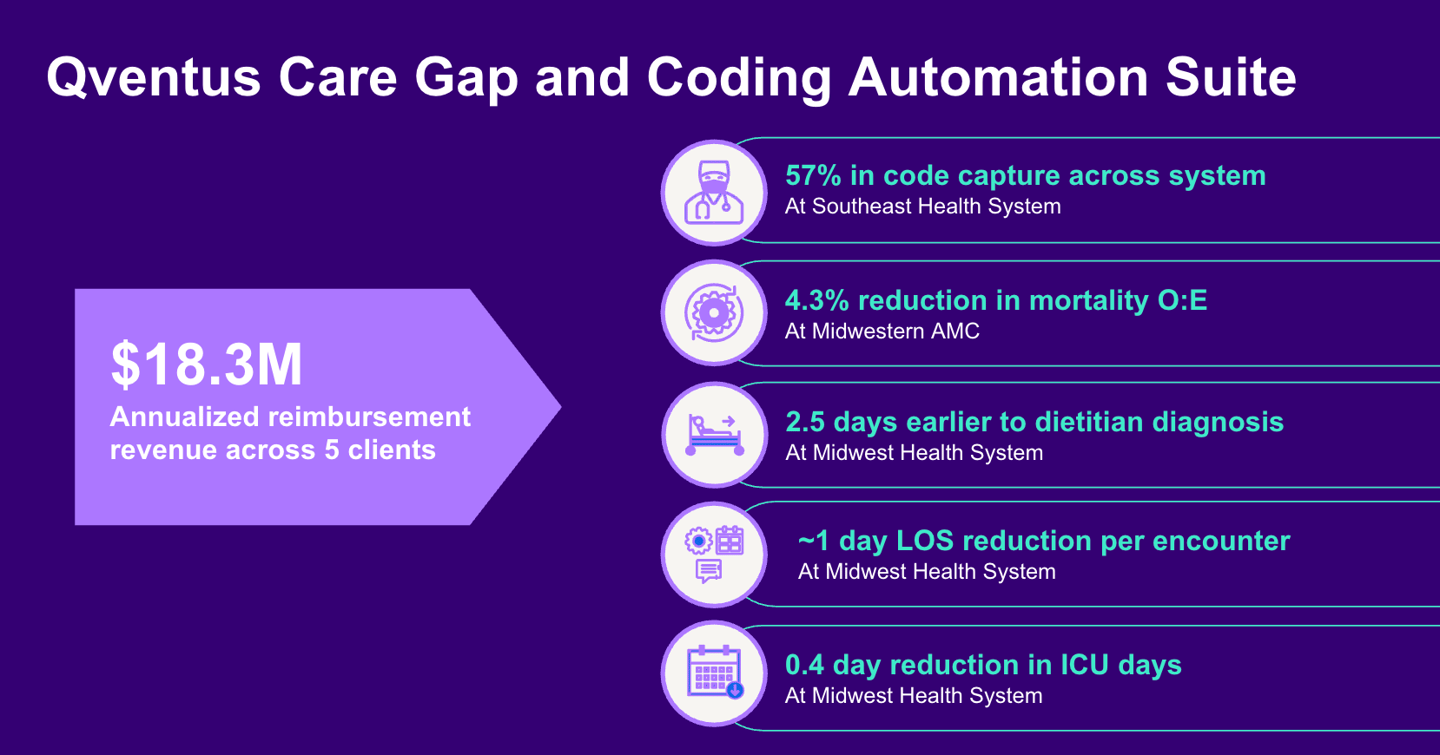
How has the first solution fared? I'm a big fan of showing the work, so here are the latest blinded results Qventus shared at its recent QLive conference. Across 5 clients, the suite has produced $18.3M in annualized reimbursement revenue in a matter of months. And the money is only part of the picture, as this chart shows:
Two earlier data points are also worth a look. At a southern academic medical center, the first deployment generated more than $350K in additional reimbursement after only 3 months, which Qventus annualizes to $1.4M. A Midwest AMC that believed its existing workflows were catching malnutrition saw a 15% lift in coding capture and projects $7.4M in annualized revenue.
The QLive panel added named-client results, with leaders from Allina Health and OhioHealth sharing how they rolled out the suite, starting with Malnutrition Care Automation. OhioHealth cut the time to nutrition care for malnourished patients by 2.5 days (the previously unnamed source in the chart), and one Allina hospital achieved a 14% increase in code capture.
What I find most interesting is the triple impact. Clinicians save significant time, because documentation is handled inside the EHR workflow they already use instead of hunting through charts. Patients get better outcomes, since they're treated sooner and can go home earlier, which contributes to lower readmission. And the hospital is appropriately reimbursed for the complexity of care it already delivered. It's rare for one workflow change to move all 3 at once.
One platform, many diagnosesCopy anchor linkCopied
Malnutrition is just one use case, not the whole story. The same system of action extends to pressure injuries, acute kidney injury, encephalopathy, and other complex conditions hidden in the chart. Each condition has its own clinical criteria, its own intervention, and its own documentation requirements, but the underlying problem is identical: the condition is real, the care is delayed, and the record doesn't reflect it.
This is where the platform argument matters. The alternative is deploying a separate point solution for every condition, each with its own implementation, contract, and interface for already stretched clinicians to learn. Qventus is betting that health systems would rather stand up one extensible platform and give care teams a consistent experience across care gaps.
It also helps that the suite builds on the integrations and operational track record Qventus has already put in place across 150+ hospital facilities, and that the company says its clients benefit from guaranteed ROI. That's the kind of risk-sharing language CIOs have been asking vendors for, and it makes a new solution a much easier sell internally.
The four-hour questionCopy anchor linkCopied
If you're already a Qventus client, here's the part that jumped out at me: Qventus says Malnutrition Care Automation is roughly a 4-hour IT lift away from going live, and points to $5,000 to $10,000 per patient in additional reimbursement, starting almost as soon as it's turned on.
If you're not a client yet, a useful exercise is a gut check. How many of your severe malnutrition, AKI, and pressure injury patients get identified on day 1 versus on day 4, or after discharge? How many of those were documented in time to support a clinical response, rather than just a claim? Those answers tell you what your own version of the $15M+ number looks like.
Long story short, flagging a gap was never going to be enough. The value isn't just in the AI that spots the condition, it's in the workflow wrapped around it. End-to-end orchestration that closes the care gap in real time, inside the workflow clinicians already use, with the documentation to back it up, is the win. As I’ve said before, that's what separates a system of action from yet another dashboard, and it's why I think Qventus is worth a close look.
To see how the Care Gap and Coding Automation Suite would work in your environment, visit the Suite page, or contact Qvenus and request a demo.